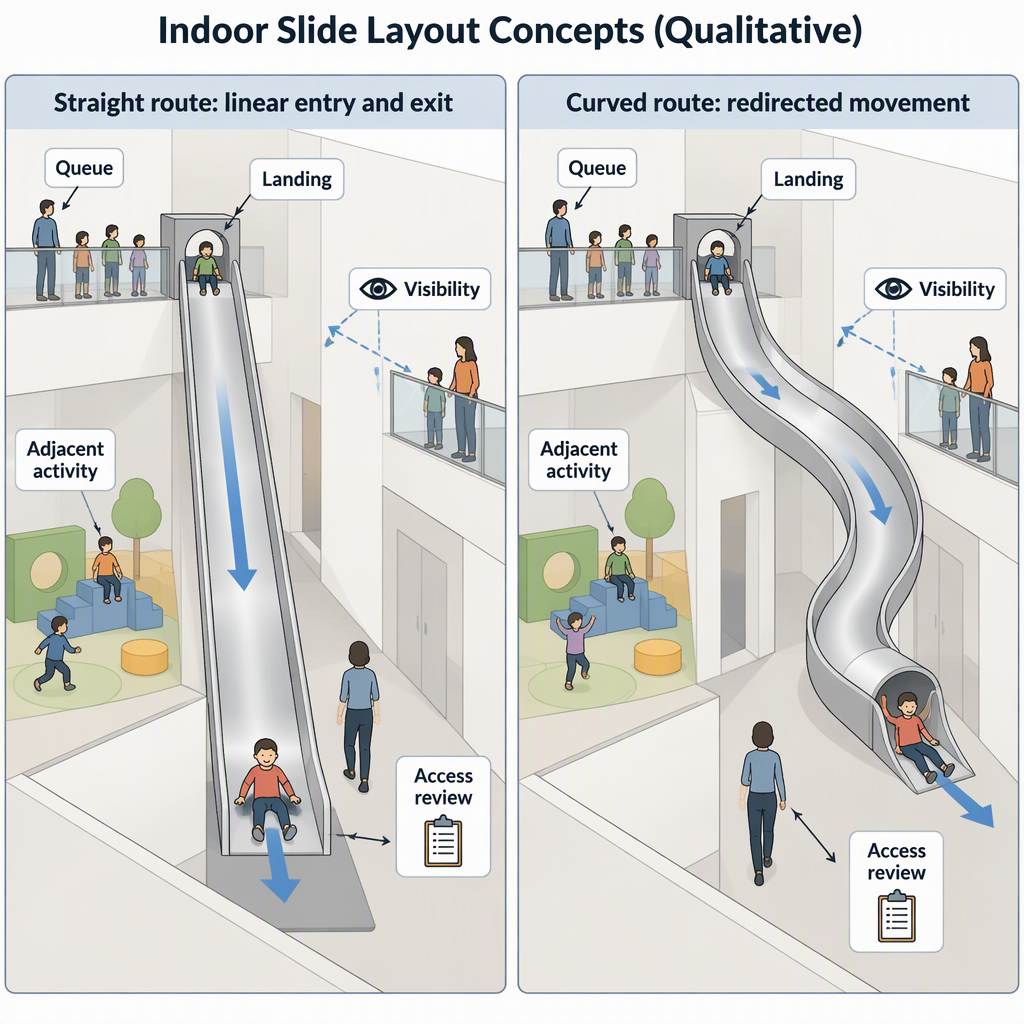
For a commercial indoor playground, a straight slide is usually the cleaner choice when the plan needs a simple linear route from platform to landing, while a curved, spiral, or wave-style slide is better when the slide must turn, become a stronger visual feature, or coordinate with surrounding activity zones. The right answer depends less on the word “curved” or “straight” and more on whether the entry, exit, landing, sightlines, access, and applicable safety review can be resolved for the specific venue and product configuration.
Curved or straight indoor slides: the short decision answer
Choose a straight indoor slide when the project needs a simple, visible, linear movement path; choose a curved, spiral, or wave-style slide when the route needs to turn, create a stronger feature, or fit around other activities, as long as the final design is checked against the applicable safety context and product-specific layout information.
Straight slide logic
Use a straight slide when the layout benefits from a clear start-to-finish direction. This can help project teams discuss the queue, platform approach, landing direction, and supervision position without first solving a turn in the slide path.
Best suited to a linear platform-to-landing route.
Useful when the exit should point toward an obvious circulation path.
Often easier to review in early blocking plans because the movement line is direct.
Curved, spiral, or wave slide logic
Use a curved or spiral path when the slide is expected to redirect movement, become a stronger attraction feature, or work around nearby play elements. The shape can solve a zoning problem, but it also makes the entry, turn, landing, and access review more important.
Best suited when the route must change direction.
Helpful when the slide is part of a more prominent play cluster.
Requires careful coordination with adjacent activities and sightlines.
For soft contained play contexts, ASTM F1918-21 is described by ASTM as a safety performance specification intended to reduce potential life-threatening and debilitating injuries; that scope makes standards review relevant to the layout discussion, but it does not by itself certify any specific slide or venue configuration.
How shape changes footprint, exit direction and circulation
A straight slide is usually easier to reason about because the entry, slide path, and exit can be discussed as one direction, while a curved or spiral slide can redirect traffic but needs closer coordination around the turn, landing, sightlines, and adjacent play zones.
Layout factor
Straight slide
Curved, spiral, or wave-style slide
Movement path
Typically planned as a direct line from elevated entry to landing.
Planned as a turning or shaped route that changes the direction of movement.
Exit direction
Useful when the landing should feed into a clear forward circulation path.
Useful when the exit must be oriented away from a conflict or toward a different zone.
Early layout review
Often easier to sketch in a first blocking plan because the route is linear.
Needs a more deliberate review of turning path, nearby elements, and landing visibility.
Design emphasis
Works well when the slide is a functional connector between levels.
Works well when the slide is intended to be a prominent feature within a play cluster.
Information to confirm
Confirm actual product dimensions, entry height, landing area, and access needs.
Confirm actual geometry, entry and exit points, turn path, landing area, and access needs.
In practice, the most important footprint question is not only “which slide body occupies less area?” A venue also needs usable space for the approach, waiting point, entry control, landing, circulation after exit, cleaning access, inspection access, and separation from nearby active zones. A compact slide body can still create a poor layout if the exit points into a crossing path, and a larger-looking slide can be acceptable if it organizes movement clearly.
Operational checks before choosing the slide path
The slide shape should be selected together with queue location, landing visibility, nearby active zones, maintenance access, and staff supervision points because a commercial attraction must work as an operating area, not just as a product placed on a plan.
Queue position: Check whether waiting users can gather without blocking stairs, platforms, trampoline entries, ninja routes, toddler areas, or café-facing circulation.
Entry control: Identify who can see the entry point and how the slide connects to the platform or play structure.
Landing visibility: Make sure the landing is visible from the intended supervision position and not hidden behind a turn, column, decorative wall, or another activity.
Exit direction: Decide whether users should continue forward, turn back into the play structure, or move toward a wider circulation route after landing.
Adjacent activities: Avoid placing the slide landing directly into another active movement path without a clear separation strategy.
Access for inspection and cleaning: Reserve practical access around the slide body and landing instead of filling every nearby area with additional play elements.
For a venue owner, the curved-versus-straight decision should be tested against the guest journey. If the slide is intended to pull attention from the entrance, a curved or spiral form may support a more dramatic focal point. If the slide is mainly a dependable connector inside a larger play structure, a straight route may be easier to integrate. If the slide sits beside high-energy activities, the landing direction may matter more than the slide shape itself.
Where the large stainless steel slide product fits in a layout discussion
The supplied Vasia product page can be used as a reference point for a large stainless steel slide playground option and for page-listed product details, while the layout decision still needs product-specific drawings and project-specific review before approval.
The Large Stainless Steel Slide Indoor Playground page identifies the product name and model VS1-241031-1680-30, and it lists material and construction information such as LLDPE plastic parts, galvanized pipes, PVC with sponge cover, and EVA mat information. The same page also states that detailed CAD instructions tailored for each design are provided.
Use the product page to start the discussion about whether a large stainless steel slide belongs in the planned indoor playground mix.
Use the page-listed model and material information when requesting configuration-specific drawings from the supplier.
Ask whether the selected design is straight, curved, spiral, wave-style, or a combination, because the catalog reference alone should not be stretched into a final layout approval.
Keep product-page certification badges or broad marketing wording out of approval documents unless the project team has separate certificate pages, applicable editions, and jurisdiction-specific review.
Separate the slide equipment scope from venue decoration, lighting, furniture, electronic interaction, and other fit-out items unless they are specifically confirmed for the project.
Vasia’s indoor playground equipment page describes custom playground solutions and indoor play centre contexts, which supports using the slide discussion as part of a broader layout conversation rather than as a standalone product choice.
A practical workflow for slide-shape layout approval
Use a layout review sequence: define the audience and activity mix, mark the platform and exit direction, compare straight and curved paths, reserve access for operation and maintenance, then request product-specific drawings before approval.
Start with the activity map. Mark the major play zones, calmer areas, circulation paths, viewing points, and any high-energy activities that should not conflict with the slide landing.
Place the entry before choosing the shape. The platform location, access route, and supervision point often determine whether a straight route is natural or a turn is helpful.
Test the landing direction. Draw where users go immediately after the slide. If the exit points into a crossing route, reconsider the orientation or shape.
Compare a straight option with a curved option on the same plan. Use the same entry point, landing requirements, and access assumptions so the comparison is fair.
Check visibility and access. Confirm that staff can see the critical areas and that the team has practical access for inspection, cleaning, and routine venue operation.
Request supplier drawings for the selected configuration. Product-specific CAD information is the point where conceptual shape preference becomes a reviewable project layout.
Route the plan through local and professional review. Standards context, local requirements, insurance expectations, and venue policies should be checked before the design is treated as final.
Ask for the exact selected slide configuration and whether it is straight, curved, spiral, wave-style, or combined.
Request entry and exit positions, product footprint, landing area, access needs, and any configuration-specific installation notes.
Request drawings that show the slide in relation to the play structure, not only as an isolated product.
Confirm which materials, finishes, and options apply to the selected configuration rather than assuming all catalog images share the same scope.
Confirm what is included in the equipment scope and what belongs to site fit-out, decoration, building work, or operations planning.
Evidence boundaries: standards, safety context and local review
Standards and public industry resources can guide the review, but they do not automatically prove that a specific slide, configuration, or venue is compliant; keep general references separate from product-specific evidence.
ASTM describes F1918-21 as a safety performance specification for soft contained play equipment. For a commercial indoor playground project, that makes the standard relevant to the review conversation, but the published listing is not the same thing as a certificate for a particular slide model, layout, installation, or operating procedure.
A strong procurement file separates three kinds of information. First, keep product facts that come from the supplier’s product page or quotation package. Second, keep standards and industry resources that guide the review framework. Third, keep project-specific approvals, drawings, inspection notes, and operating procedures for the actual venue. Mixing those categories is where many layout misunderstandings begin.
Conclusion
A straight slide is usually the lower-complexity choice for a linear route, while a curved slide is better treated as a layout feature that must earn its space by improving direction, experience, or zoning without compromising reviewable access and visibility.
Choose straight when the project benefits from a direct platform-to-landing route.
Choose curved, spiral, or wave-style when the slide needs to redirect movement or become a stronger feature.
Judge footprint by the working area around the slide, not only the slide body.
Request product-specific drawings before treating any shape preference as an approved layout.
Keep product facts, standards context, and venue approvals in separate review categories.
FAQ
These answers focus on practical commercial layout decisions and avoid unsupported claims about exact clearances, capacities, certifications, operating outcomes, or financial performance.
Is a straight indoor slide always more space-efficient?
No. A straight slide may be easier to plan as a linear route, but the real footprint includes the platform approach, landing, exit circulation, access, and nearby activities. A straight route that exits into a conflict can be less usable than a curved route that organizes movement better.
When does a curved or spiral indoor slide make sense?
A curved or spiral slide makes sense when the layout needs to change direction, work around another zone, create a stronger feature, or direct users toward a better landing path. It should still be checked with configuration-specific drawings and venue review.
Can a catalog page prove that a slide layout is approved?
No. A catalog or product page can identify the product and listed details, but final layout approval needs the selected configuration, drawings, applicable requirements, and project review. The Vasia product page states that detailed CAD instructions tailored for each design are provided, which is useful for the next review step.
Should the slide shape be chosen before the rest of the play structure?
Usually, it should be chosen together with the broader activity plan. The slide entry, exit, queue, landing, supervision position, and nearby active zones all affect whether a straight or curved route works.
What should be checked before placing a slide beside trampoline or ninja activities?
Check whether the landing and exit route conflict with high-energy movement, waiting users, staff sightlines, or access needs. If the slide belongs in a mixed-activity venue, the transition between zones matters as much as the slide shape.
Does ASTM F1918-21 certify a specific indoor slide?
No. ASTM’s page describes F1918-21 as a safety performance specification for soft contained play equipment, but that listing does not certify a specific product, installation, layout, or venue. Product-specific proof requires separate documentation.
What supplier information should a project team request?
Request the selected configuration, model reference, entry and exit positions, product footprint, landing area, access needs, material and option scope, and CAD drawings that show the slide in relation to the surrounding indoor playground layout.
Can one slide shape be recommended for every commercial indoor playground?
No. The right shape depends on the venue plan, activity mix, supervision approach, available space, and applicable review path. A straight slide and a curved slide can both be appropriate when their working areas are properly resolved.