
When the item is a bed
Discuss it with the trampoline court, the elastic or suspension system, the enclosure, surrounding pads and fixings. Ask how the supplier identifies replacement beds for that exact configuration.

Views: 0 Author: Site Editor Publish Time: 2026-10-29 Origin: Site


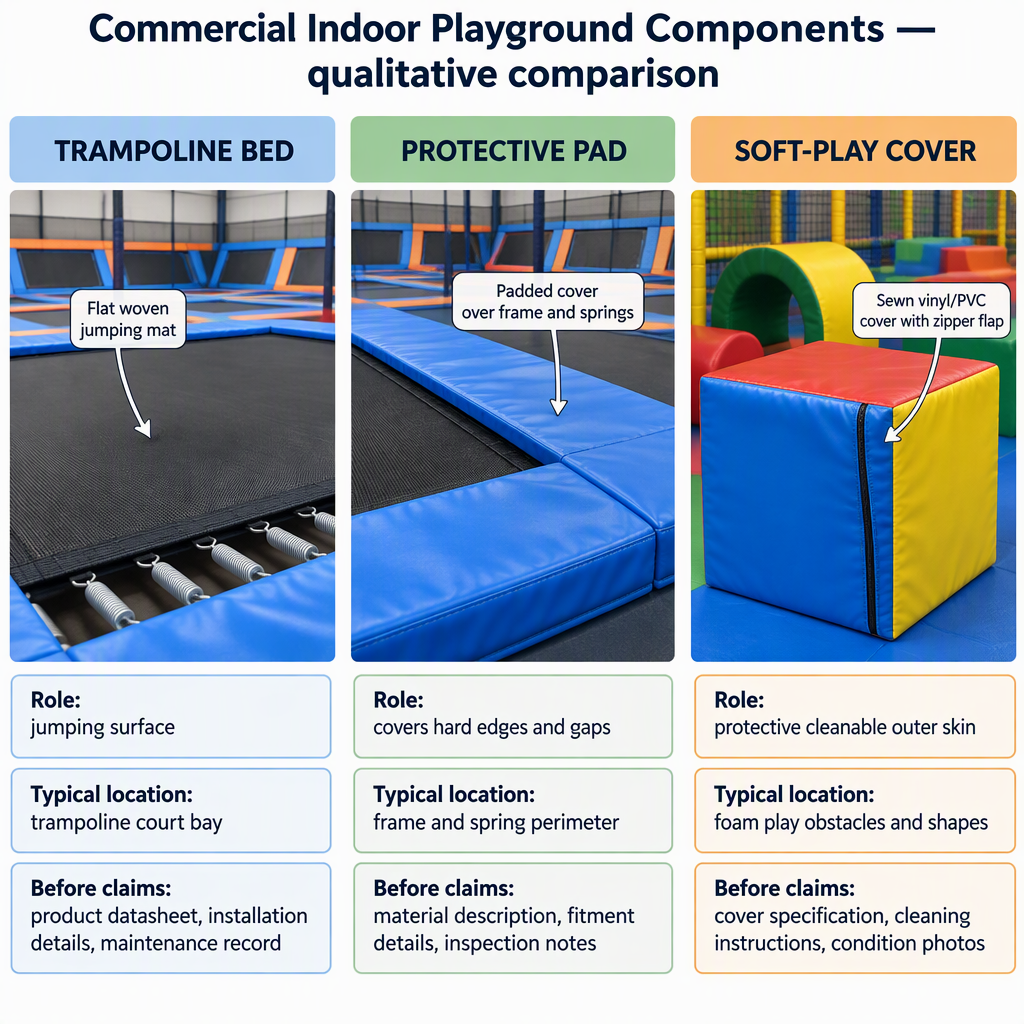
Trampoline beds, pads and soft-play covers should be planned as different component families: the bed is the jumping surface within the trampoline system, pads protect surrounding hard or exposed areas, and soft-play covers finish padded play-structure parts rather than acting as trampoline beds.
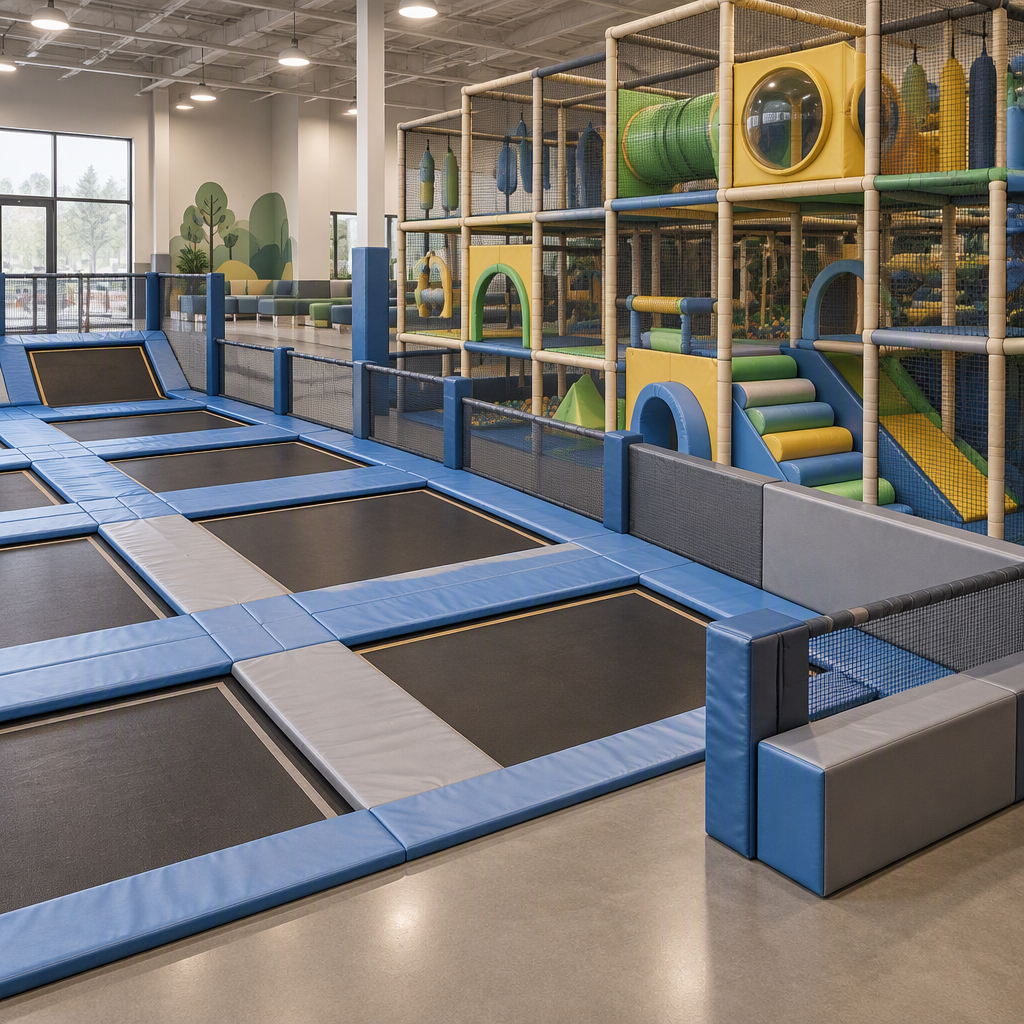
A commercial indoor play venue often combines several activity systems in one room. Vasia product examples show combined layouts where an enclosed multi-level soft-play structure sits near a separate trampoline court, and another layout where central trampoline beds are surrounded by padded borders and jungle-themed play structures. Those examples are useful because they show why component names matter: the jumping field, the protective edges and the upholstered play-structure surfaces belong to different conversations.
| Component family | Main role in the venue | Where buyers usually separate it in discussion | What not to assume |
|---|---|---|---|
| Trampoline bed | The surface within the trampoline zone that participants jump on as part of the trampoline system. | Trampoline court schedule, bed replacement references, suspension or elastic system, surrounding frame and enclosure interfaces. | Do not treat it as the same item as upholstery, wall padding or a decorative cover. |
| Protective pad | A padded element used around borders, exposed transitions or edges in the trampoline or play area. | Padding schedule, pad cover, fastening method, edge location, inspection access and replacement route. | Do not assume a pad can replace the jumping bed or prove impact performance without product documentation. |
| Soft-play cover | An upholstered covering over padded soft-play parts such as play-structure shapes, barriers or themed elements. | Soft-play structure schedule, fabric or covering type, foam or sponge backing, seams, joints, removable panels and cleaning instructions. | Do not assume a soft-play cover is a trampoline component merely because it feels padded. |
For example, one Vasia combined indoor playground and trampoline layout describes a multi-level enclosed play structure on one side and a separate bank of trampoline courts across the floor. Its listed play-structure specification includes galvanized steel pipe, plastic components, PVC covering with sponge and EVA mats specified by order for that referenced product page only.
Another Vasia professional kids indoor trampoline playground page describes a central grid of jumping beds, padded borders and surrounding jungle-themed play structures. That page supports the practical habit of discussing trampoline-zone components and surrounding play-structure components separately, without turning the page description into a universal specification for every project.
The three components are not interchangeable because each sits in a different equipment system and should be specified, inspected and replaced according to its own function and source documentation.
For procurement, the practical risk is not only choosing the wrong word. It is receiving a quote, drawing or maintenance pack that blends a trampoline bed, border pad and soft-play cover into one line item. When that happens, the owner may not know which part can be replaced, which part connects to a suspension system, which part is upholstery, and which part requires access to fixings or joints.
The Vasia trampoline playground example identifies central jumping beds, padded borders and surrounding play structures as visible parts of one mixed activity environment. That supports a simple rule for project teams: component boundaries should follow the activity system, not just the softness of the surface.
Discuss it with the trampoline court, the elastic or suspension system, the enclosure, surrounding pads and fixings. Ask how the supplier identifies replacement beds for that exact configuration.
Discuss its location, attachment, cover, inspection access and relationship to the trampoline frame, platform edge, walkway or transition point. A pad protects an area; it is not the jumping bed.
Discuss it with the soft-play structure, foam or sponge backing, PVC or other covering, seams, shaped elements and the play-structure material schedule for the specific product.
In practice, this distinction also keeps maintenance conversations cleaner. A torn bed, a worn pad cover and a damaged soft-play seam may all be visible to staff, but they are not the same repair problem. Each should point back to its own part reference, material description, fixing method and supplier instruction.
Use standards as scope references, not as proof that a specific product complies; a named standard in a conversation should lead to official status checks, supplier documentation and project-specific professional review.
| Question for the team | Why it matters | What the buyer should request |
|---|---|---|
| Which activity system is being discussed? | A trampoline court, an impact-attenuating surface and a soft-contained play structure may sit in the same room but still fall under different technical conversations. | A component schedule that separates trampoline beds, pads, enclosure parts, soft-play covers and play-structure elements. |
| Is the standard current and relevant? | A document title alone does not confirm current status, project applicability or local acceptance. | Official publisher status, the edition being used and written confirmation of the scope applied to the project. |
| Does the supplier claim compliance? | Compliance is a product and project claim, not something that follows automatically from a component name. | Product-specific certificates, test reports or declarations that identify the exact component, model, date and scope. |
| Who verifies the project? | Venue operators may face local rules, insurer expectations and professional design requirements beyond a product page. | Advice from qualified local professionals and the final supplier documentation before opening. |
Do not use a standards title as shorthand for safety, certification or legal approval. In a buyer meeting, the useful question is narrower: which component, which document, which edition, which test evidence and which project condition are being discussed?
This section is intentionally cautious. Public page access in many standards environments may show titles or status but not the full technical text. For a live project, treat public titles as orientation only and request the actual documents, reports and professional sign-off that apply to the venue location and final equipment configuration.
A mixed venue should keep the trampoline system, soft-play structure and transition areas in separate schedules so the buyer can track beds, elastic systems, pads, enclosures, covers, nets, slides, fixings and replacement parts without blending them into one vague package.
This matters in layouts like Vasia's combined indoor playground and trampoline park examples, where trampoline zones and soft-play structures appear as related but distinct activity areas. Owners can review the combined indoor playground and trampoline park page and the professional kids indoor trampoline playground page as examples of why the schedule should not collapse all soft-looking surfaces into one category.
| If the item is in... | Schedule it under... | Ask for... |
|---|---|---|
| The jumping field | Trampoline system | Bed identification, suspension interface, surrounding pad relationship and replacement method. |
| The edge around a trampoline or transition | Protective padding | Location, attachment, cover material, inspection access and whether it is removable. |
| An enclosed multi-level play structure | Soft-play structure | Frame, plastic or play components, covering, foam or sponge layer, mat and part references for that product. |
| A themed or decorative area | Optional finish or venue design item | Written confirmation that it is included in the equipment scope before treating it as supplied. |
Layout planning should leave understandable circulation and service access around each activity area because beds, pads, covers, enclosure points and soft-play joints are reached and managed in different ways.
The product examples show trampoline zones and soft-play structures arranged as different activity areas within indoor venues. That does not establish universal dimensions or operating capacity, but it does support a planning habit: mark how staff reach the trampoline bed field, the padded borders, the enclosure, the soft-play structure and the return routes before the order is finalized.
Good layout coordination is not the same as inventing dimensions. If the project needs clearances, participant limits, staff positions or inspection intervals, the owner should obtain those from the final supplier documents, local professionals and applicable venue requirements.
At handover, operators should request instructions and part references by equipment group, while avoiding unsupported cleaning chemistry, frequency or inspection claims unless the final supplier documents and local requirements specify them.
A useful handover pack for a mixed trampoline and soft-play venue should not be organized only by room name. It should also follow component roles. The trampoline bed, protective pads and soft-play covers may be cleaned, inspected and replaced through different instructions, and those instructions should be tied to the selected product configuration.
Do not invent cleaning chemicals, inspection frequency, repair thresholds or opening rules from a product image. Those details need the final manual, confirmed material compatibility, applicable local requirements and the operator's own procedures.
For broader professional development beyond product documents, IAAPA presents its education resources as a hub for attractions professionals covering topics such as safety, security, sustainability, accessibility and guest experience. Use that kind of industry resource for operational context, not as proof of a specific trampoline bed, pad or soft-play cover specification.
Product pages can verify visible product descriptions and listed specifications for the referenced products; they do not by themselves prove certification, measured performance, legal compliance or operating outcomes for a specific project.
When comparing commercial trampoline components, keep the difference between description and proof clear. A page may show a layout with trampoline beds and soft-play structures. It may list a material schedule for a specific product. That is not the same as a project-specific test report, local approval, capacity statement, fire-performance result, impact-attenuation result, cleaning compatibility sheet or customer outcome.
The practical decision is to ask for a layout and schedule that names each component by role, evidence source and replacement path, instead of treating trampoline beds, pads and soft-play covers as one generic soft surface.
For commercial indoor playground investors and operators, the component names are not minor details. They affect ordering, layout review, handover, staff reporting and future replacement discussions. A trampoline bed belongs to the trampoline system. A protective pad belongs to the edge, border, transition or exposed area it protects. A soft-play cover belongs to the padded play-structure element it finishes.
The best next step is to turn the room plan into a component schedule before signing off the equipment package. Ask the supplier to identify each bed, pad, cover, enclosure part, play-structure element, fixing and replaceable item for the final configuration. Then keep unsupported claims out of the decision until product-specific documents, official standards information and local professional requirements are available.
Commercial buyers usually need short, component-specific answers that avoid unsupported specifications, prices, certifications and operating promises.
In many buyer conversations, the bed is the jumping surface within the trampoline system. Use the supplier's final terminology and part list for the exact product so purchasing, inspection and replacement discussions use the same name.
No. A protective pad and a trampoline bed serve different roles. The pad belongs around an edge, border, transition or exposed area, while the bed is part of the jumping field. Treating one as the other can confuse ordering and maintenance.
They may appear in the same venue, but they usually belong to the soft-play structure or padded play elements rather than the trampoline bed system. Mixed layouts should separate the trampoline-zone schedule from the soft-play schedule.
Ask for the final component schedule, material descriptions for the selected configuration, replacement-part references, cleaning and care instructions, inspection points, attachment details and any product-specific compliance documents that the supplier can provide.
No. A product image can help identify visible activity areas, but material specifications, included options, certifications and compliance claims need written documentation for the exact product and project.
Do not assume that. Ask for material-compatible instructions for each confirmed component. A trampoline bed, a pad cover and a soft-play cover may have different care requirements depending on the final materials and supplier documentation.
Use the component schedule. Staff should report whether the issue is on a bed, border pad, enclosure part, soft-play cover, seam, fixing or transition area so the operator can route it to the right inspection and replacement process.
Use standards to frame questions, not to assume approval. Ask which official document, edition, component, test report and project condition the supplier is referring to, and confirm local requirements with qualified professionals.
