


Packed indoor playground components will fit through your building only when the largest packed pieces, the measured access route and the handling method are checked together before shipment. A public product page can identify the play product and its listed support scope, but it cannot replace a configuration-specific packing list, site measurements or a delivery route review.
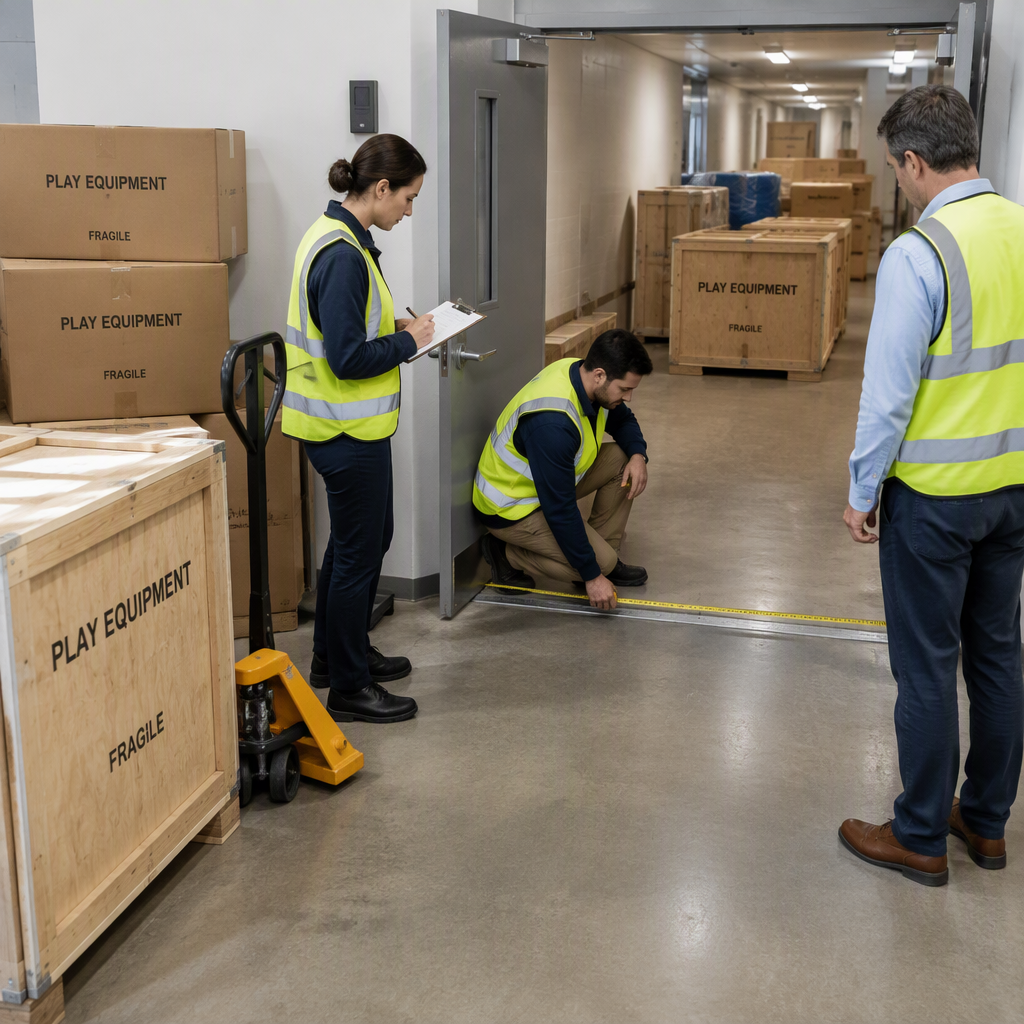
Will the packed playground components fit through your building?
Packed indoor playground components will fit only if the largest packed pieces, the route clearances and the handling method are checked together before shipment; the public product page does not provide enough packing detail by itself.
For a commercial indoor playground, the fit question is not the same as asking whether the finished layout looks suitable for the room. The selected Factory Direct Sales Indoor Park for Kids page identifies an indoor park product, lists material categories such as plastic parts, joints, PVC, sponge, iron parts and EVA mat, and states that installation support includes professional CAD instruction with a step-by-step procedure guide.
Those details help a venue owner understand the product family and installation-support wording, but they do not publish the packed carton or crate dimensions, component weights, maximum single-piece size, unloading method or access requirements for a specific ordered configuration.
In practice, this means your project team should compare supplier-held packing data with venue-held route measurements. If either side is missing, shipment approval is premature.
Measure the route before you approve packing or shipment
Measure the complete route from unloading point to final play area, not just the front door: dock or entry, thresholds, corridors, turns, elevators, stairs, ceiling obstructions, floor condition and temporary staging space all affect the handling decision.
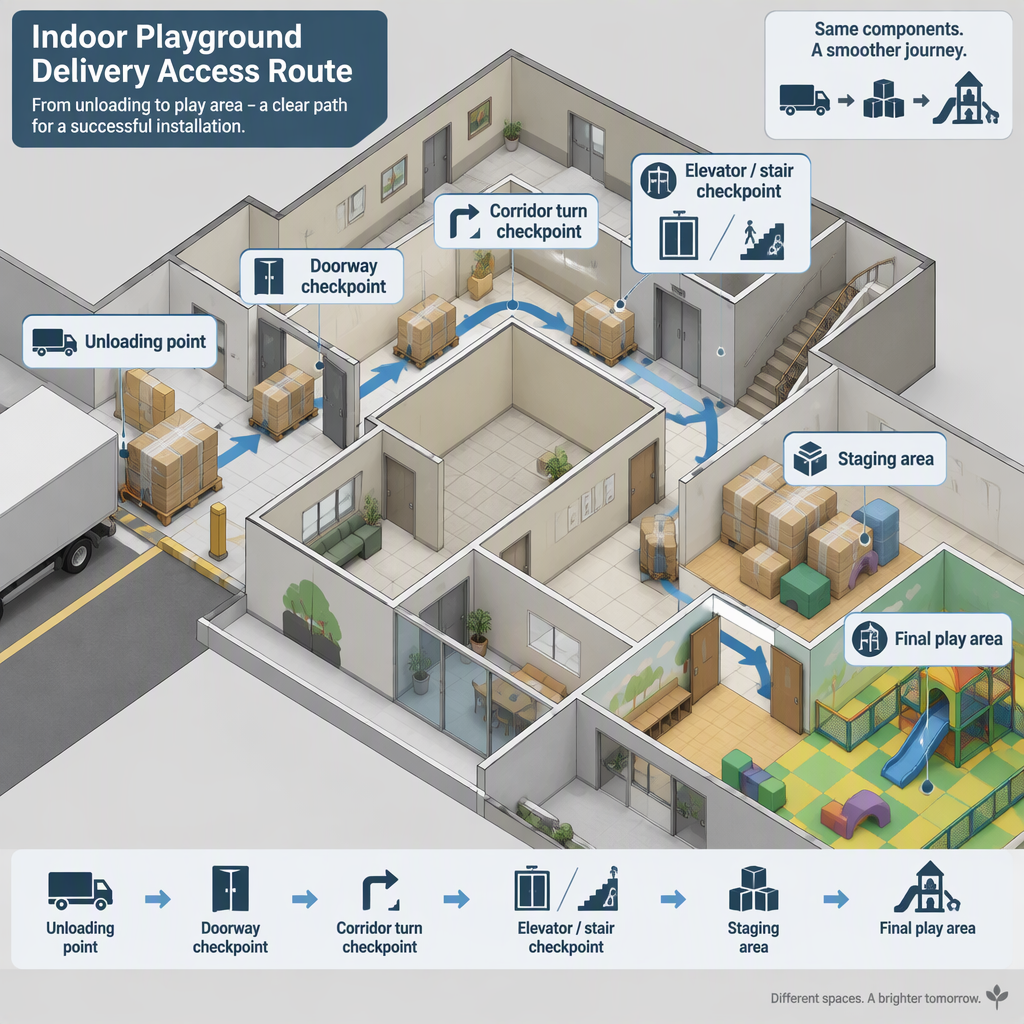
The most common planning error is to measure only the entrance door. A packed play component may pass through the door but fail at a corridor turn, elevator interior, low ceiling zone, service corridor, raised threshold or final room opening. HSE manual-handling assessment guidance supports looking at the load, the carrying distance, cramped areas, floor surfaces, lighting and the working environment rather than treating the opening width as the only variable.
- Record the unloading point, including dock, kerbside, service entrance or mall back-of-house route.
- Measure the clear opening of every doorway after allowing for door leaves, handles, closers, frames and protective coverings.
- Check thresholds, ramps and changes in level because they affect rolling, carrying and mechanical handling.
- Measure corridor width, ceiling height and the diagonal space needed at turns.
- Confirm elevator clear door opening, internal depth, internal width, ceiling height and rated operating constraints with the building team.
- Identify stairs, landings, handrails, sprinkler heads, signs, lights and other fixed obstructions.
- Check floor condition, slope, surface protection needs and whether the route can support planned handling aids.
- Reserve staging space near the final installation area so packed parts do not block operations or emergency paths.
- Start outside the building. Trace the exact path from vehicle position to building entry, including turning room for handling equipment.
- Measure the narrowest point first. The smallest clear opening or tightest turn often determines whether the route is workable.
- Check the vertical path. Elevators, stairs and ceiling obstructions can be more restrictive than door width.
- Mark every change in direction. Long packed pieces need turning space, not only straight-line clearance.
- Photograph and label route points. Share annotated measurements with the supplier and the local site team so both sides discuss the same constraints.
A simple measured route map is more useful than a general floor plan. It should show each pinch point in sequence and include notes on surfaces, lighting, temporary obstructions and staging limits.
Ask for the packing data that decides the fit
Request a packing list that identifies the largest packed pieces, weights, handling restrictions and whether any components can be safely separated or unpacked before final placement; do not infer this from a rendering or category page.
A product image or layout rendering shows the intended play experience, not the shipping geometry. The first-party product page supports only the visible product description, listed material categories and installation-support wording; it does not verify packed dimensions, component weights, centre-of-gravity notes or a maximum single-piece size for a particular slide and ball-play layout or jungle cabin and slide layout.
- Largest packed item: length, width, height and whether the dimensions include pallet, carton, crate or protective frame.
- Weight of each major package and the heaviest single package.
- Whether each package may be tilted, stood upright, rolled, stacked or must remain in a specified orientation.
- Handling points, lifting restrictions and any surfaces that must not be used for pushing or pulling.
- Package labelling sequence and whether labels correspond to the installation guide.
- Which pieces, if any, may be separated before reaching the final room.
- Required site equipment, such as pallet truck, forklift, lift table or other handling aid, when applicable to the confirmed package.
- Unloading assumptions, including delivery vehicle access, loading dock expectations and staging space.
The specified Vasia product page states that installation support includes professional CAD instruction and a step-by-step procedure guide. That is useful during installation planning, but a building access check still needs packing information for the exact ordered configuration. Keep those two documents separate: the installation guide helps the assembly sequence, while the packing list helps the delivery route decision.
If the supplier has not yet issued the final packing list, use the access route measurements to flag risk early. The supplier can then review whether packing, sequencing or route assumptions need discussion before production or shipment is approved.
Use bottlenecks as go, change or stop points
If a route point looks tight, treat it as a decision point: compare the packed size against the measured opening, then decide whether to change the route, use suitable handling equipment, request smaller packing, stage components differently or pause shipment approval.
A bottleneck is not automatically a failure. It is a point where the team must decide whether the current plan is acceptable. HSE risk-reduction guidance recommends using mechanical help where possible, making loads smaller or lighter and easier to grasp where possible, breaking large consignments into smaller loads where possible, and modifying the workplace to reduce carrying distance, twisting and difficult lifting positions.
| Access issue | What to check | Practical decision |
|---|---|---|
| Doorway is narrower than the largest package | Clear opening, door removal possibility, frame protection and package orientation limits | Ask whether packing can be changed, whether another route exists or whether shipment approval should pause. |
| Corridor turn is tight | Diagonal turning space, package length, wall protection and worker positioning | Test the turn on the route drawing before delivery; consider alternate staging or route changes. |
| Elevator is restrictive | Door opening, internal dimensions, loading rules and building approval | Confirm whether the package can enter, turn and exit without unsafe lifting or forced angles. |
| Stair is the only route | Landing size, handrails, package weight, carrying distance and worker safety | Escalate before shipment; do not assume manual carrying is acceptable for large or heavy packages. |
| Floor or lighting is poor | Surface condition, slope, protection needs and visibility | Improve the route before delivery or select a route where handling aids can be used appropriately. |
Do not assume unpacking early is safe or allowed
Early unpacking is not a default solution; it should be used only when the supplier confirms it will not damage parts, lose labels or compromise installation sequencing, and when the site can protect and stage the separated parts safely.
Breaking large consignments into smaller loads can reduce handling difficulty where it is possible and appropriate. However, that general principle does not prove that every indoor playground package can be opened before it reaches the final play area.
Indoor playground packages may contain parts needed in a defined installation sequence, and the specified product page refers to CAD instruction and a step-by-step guide rather than publishing a public early-unpacking method. For that reason, early unpacking should be treated as a controlled option, not an improvisation at the building entrance.
- Confirm in writing which packages, if any, may be opened before reaching the final room.
- Keep labels, part numbers and packing references attached or recorded.
- Protect components from dirt, moisture, impact and unauthorised movement during staging.
- Maintain a clear sequence so the installation team can match parts to the CAD instruction and step-by-step guide.
- Do not block corridors, exits, shared service routes or operational areas while staging components.
- Assign one person to control the unpacking record so loose parts are not mixed between zones.
Assign access responsibilities before shipping
The supplier should confirm packing and component data, while the venue team or local project team should verify the actual building route, landlord constraints, work hours, protection needs and local approval requirements.
The Vasia indoor playground equipment page describes custom indoor playground solutions, space planning and design support, and installation-related support for commercial indoor playground projects. That supports a planning discussion with the supplier, but it does not transfer local route measurement or building-access responsibility away from the venue team.
| Task | Best owner | Reason |
|---|---|---|
| Confirm largest packed dimensions and package list | Supplier | The supplier controls configuration-specific packing information for the ordered equipment. |
| Confirm product page and installation-support scope | Supplier and buyer | The product page supports product identification and stated installation-support wording. |
| Measure route from unloading point to final play area | Venue or local project team | The route is site-specific and depends on the actual building, doors, lifts, stairs and temporary conditions. |
| Approve landlord work rules, delivery hours and route protection | Venue, landlord or building manager | These rules depend on the building and local management requirements. |
| Assess handling method and worker capability | Local contractor or qualified handling team | Handling decisions depend on task, load, route environment and available capability. |
| Decide whether to approve shipment | Buyer’s project lead | The decision should combine supplier packing data, measured route data and site approvals. |
Use first-party pages for what they can verify: the specified product identity, stated material categories and installation-support wording, and the broader availability of custom indoor playground planning support. Do not use those pages as proof of unlisted packing dimensions, route fit, delivery timing or local approval status.
If your team is evaluating a similar commercial layout, compare the access route against the specific ordered configuration rather than assuming that all indoor playground packages behave the same way.
Prepare the site for delivery day
A delivery-day checklist should confirm the route is clear, surfaces are protected, handling aids and workers are ready, labels match the packing list, and components can be stored without blocking operations or emergency paths.
Good delivery preparation reduces the chance that a workable route becomes unworkable on the day. Temporary obstacles, poor lighting, wet floors, missing keys, unavailable elevators or an unprepared staging area can undermine a route that looked acceptable on paper.
- Clear the route before the truck arrives, including back-of-house corridors and final room access.
- Protect floors, corners, walls, glass, doors and finished surfaces where movement may occur.
- Confirm the handling aids planned for the package and route are present and usable.
- Confirm the delivery team has the route map, packing list and contact person.
- Check lighting, ventilation and surface conditions along the route.
- Reserve staging zones that do not block emergency paths, public access or other contractors.
- Match package labels against the packing list before components are moved away from the unloading point.
- Keep the installation sequence visible so staged parts can be found when required.
- Hold a route briefing. Review the unloading point, route sequence, bottlenecks and stop points.
- Inspect conditions immediately before movement. A route measured earlier may change because of temporary works, stored materials or building operations.
- Move the most restrictive package with extra control. The largest or most awkward package tests the route assumptions.
- Stop at unexpected resistance. Do not force a package through a tight point; re-check measurements and handling options.
- Record exceptions. If packaging is damaged, labels are missing or the route changes, document it before further movement.
Use industry resources as context, not as a fit guarantee
Industry resources can help operators build broader project knowledge, but they do not replace configuration-specific packing data, measured site access or local professional review for a delivery-fit decision.
Attractions-industry education can be useful for owners who are building internal project knowledge. IAAPA presents education resources for attractions professionals and also describes research and reports for industry data and operational benchmark information.
For the building-fit decision, the strongest evidence remains the combination of supplier packing data, the measured route and a handling plan matched to the real working environment.
Conclusion
The safest planning position is to approve shipment only after the packing list, largest packed dimensions, handling method and measured access route have been checked together by the responsible project parties.
For a commercial indoor playground investor or project manager, the question is not whether the finished play space can be attractive; it is whether the packed components can travel from the vehicle to the final installation area without unsafe assumptions. The public product information can support product identification and installation-support wording, while handling guidance supports a disciplined review of load, task, route and working environment. The final fit decision still needs configuration-specific packing details and site measurements.
- Do not approve shipment from renderings or category information alone.
- Measure the whole route, including turns, lifts, stairs, thresholds, surfaces and staging areas.
- Ask for the largest packed dimensions, weights, handling restrictions and package sequence.
- Treat bottlenecks as decision points where the route, packing or handling plan may need to change.
- Use early unpacking only when it is confirmed for the package and controlled by the site team.
- Assign supplier, venue, landlord and contractor responsibilities before delivery day.
FAQ
These answers address common delivery-access questions without adding unsupported product dimensions, universal approval claims or guaranteed outcomes.
Can the product page tell me whether the packed playground will fit?
No. The specified product page identifies the indoor park product, material categories and installation-support wording, but it does not publish configuration-specific packed dimensions, weights or building access requirements.
What is the first measurement we should take?
Start with the full route from unloading point to final play area. The narrowest opening matters, but turns, corridors, elevators, stairs, ceiling height, floors and staging space can be equally important.
What should we ask the supplier before shipment?
Ask for the packing list, largest packed dimensions, package weights, handling restrictions, package sequence, unloading assumptions and whether any component can be separated or unpacked before final placement.
What if one doorway or turn appears too small?
Pause the approval decision and compare the package data with the measured point. Then review another route, mechanical handling options, adjusted packing, controlled staging or a stop decision before shipment proceeds.
Is unpacking outside the room a good workaround?
Only when it is confirmed for the actual package and the site can protect, label and stage the parts. Early unpacking should not be improvised because it can affect labels, protection and installation sequence.
Who should own the access check?
The supplier should provide packing and component data. The venue or local project team should measure the building route, confirm work rules and coordinate handling conditions.
What should be ready on delivery day?
The route should be clear, surfaces protected, handling aids available, workers briefed, package labels checked and staging space reserved so components can be moved without unnecessary carrying, twisting or obstruction.
Do attractions-industry resources replace a route survey?
No. They can support broader operator education, but they do not prove that a specific packed playground will fit through your particular building route.
