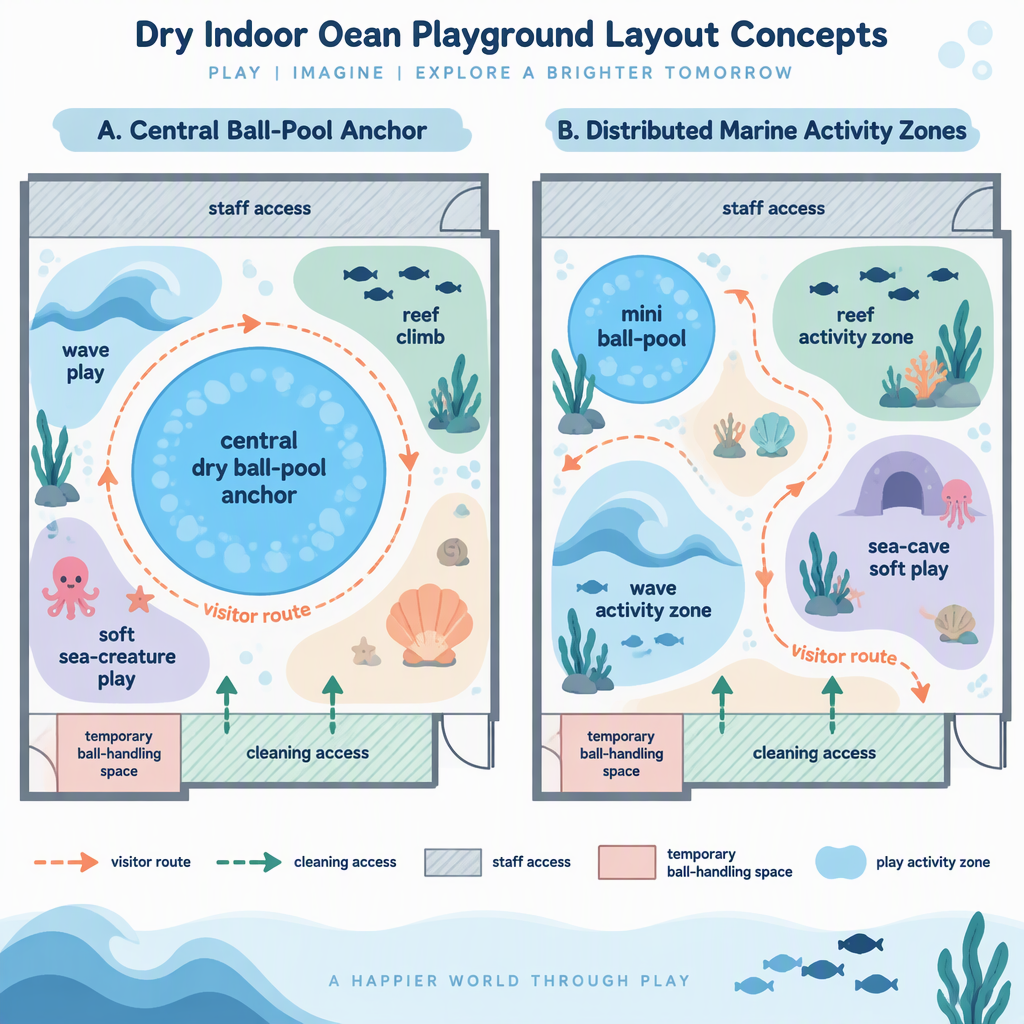
For most commercial projects, the first decision is not the ocean theme itself but the activity emphasis: a ball-play-led layout makes the pool the anchor, while a marine-adventure-led layout distributes attention across slides, climbing routes and themed dry-play features.
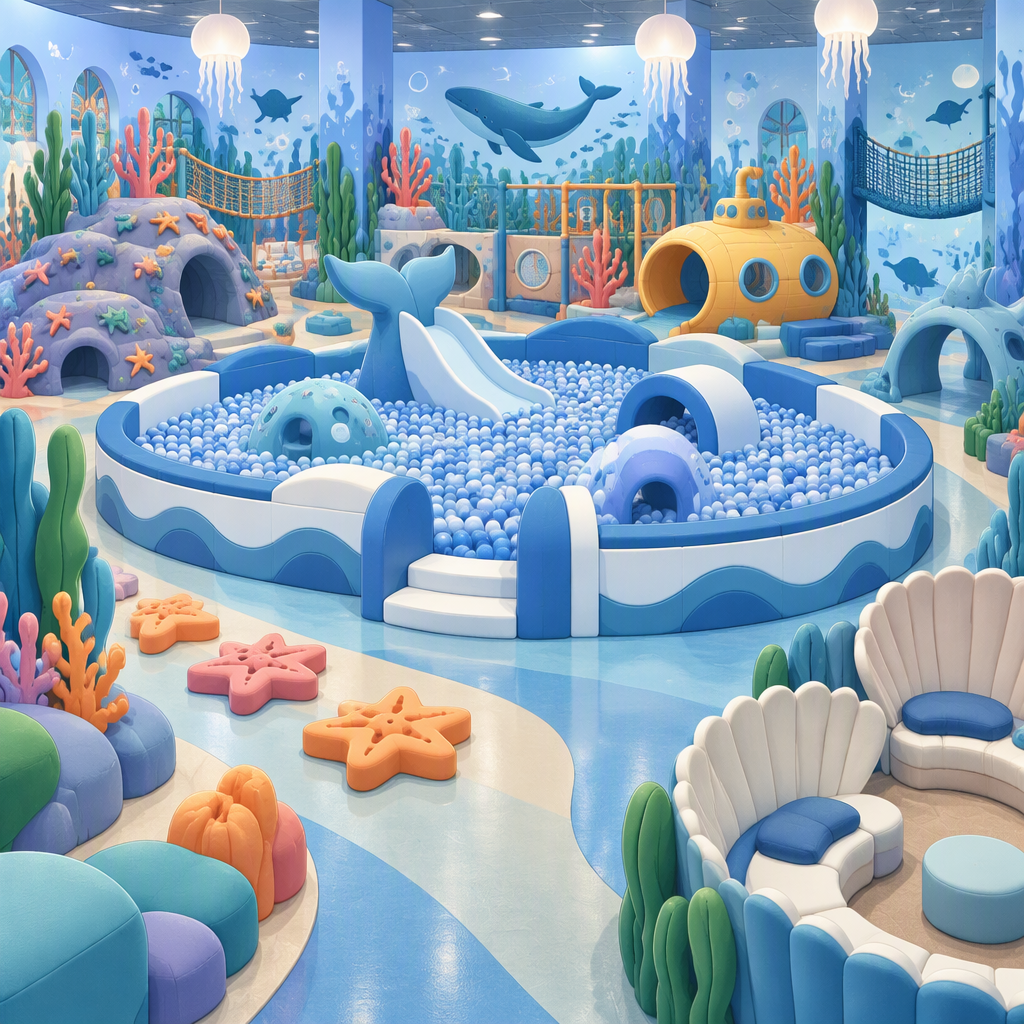
The specified ocean-theme indoor playground concept is a dry indoor play layout built around a blue-and-white ball pool, elevated structures, sliding routes, climbing elements and marine-style details. That makes it useful for a commercial investor who wants an ocean identity, but it does not automatically answer which activity should dominate the floor plan.
The practical question is whether the ball pool should act as the visual and activity center, or whether the same theme should be divided into several shorter adventure stops. Both approaches can support an ocean playground activities concept, but they create different requirements for sightlines, route planning, staff access and specification control.
Ball-play-led ocean layout
Use the ball pool as the main anchor, with slides and elevated routes feeding attention back toward the pool area.
Best when the room benefits from one strong central feature.
Requires careful planning for pool boundary, ball handling and staff access.
Works well when the ocean identity is expressed through a clear water-like visual center without adding real water play.
Marine-adventure-led ocean layout
Use the ocean theme to connect several activity stops, such as sliding, climbing and smaller themed play features.
Best when the room needs distributed activity choices rather than one dominant pool.
Requires each active feature to be specified by function, approach and exit.
Helps avoid treating marine decoration as if it were the activity plan.
Decision point
Ball-play-led design
Marine-adventure-led design
Main planning focus
Pool boundary, ball quantity, slide relationship and access around the pool.
Activity sequence, approach and exit for each slide, climbing route or themed feature.
Visitor movement
Movement often gathers around the pool and connected routes.
Movement is divided across multiple activity stops, so the route needs clearer sequencing.
Staff access
Staff must be able to reach the pool edge, base area and surrounding circulation zone.
Staff must be able to reach more separate features without blocking the main visitor route.
Cleaning planning
Ball handling, visible dirt checks and access to high-touch surrounding surfaces need to be planned.
More individual contact points and approaches may need staged inspection and cleaning access.
Specification risk
A large pool can crowd out other activities if the brief does not reserve space for routes and access.
Many themed elements can become decorative clutter if their active purpose is not defined.
For standards scoping, ASTM F1918-21 is publicly identified by ASTM as an active standard for soft contained play equipment, and its public scope excludes water-related attractions and devices. That boundary matters because an ocean theme should not be confused with a water-play installation.
When a central ball-pool layout is the better lead
A ball-play-led ocean playground is strongest when the venue wants a clear central activity, simple visual focus and slide routes that return attention to the pool, but it also requires practical access for ball removal, base cleaning and surrounding circulation.
A central ball-pool layout can make the ocean concept instantly readable. The blue-and-white pool visually suggests the sea, while elevated play structures and slides can frame the pool as the main activity area. This is useful when the venue wants a design that is easy for families and staff to understand at a glance.
The trade-off is that the ball pool is not just a decorative color field. It is an activity zone with a boundary, ball quantity, surrounding surfaces and adjacent routes. If the pool becomes too dominant, it can reduce space available for approach paths, staff movement and secondary activities.
Use a ball-play-led layout when the room needs one obvious anchor rather than many competing features.
Confirm how slides and elevated routes relate to the pool, including where users approach, enter, exit and rejoin circulation.
Define the pool boundary and adjacent flooring coverage in the procurement brief instead of assuming the rendered theme explains the order scope.
Plan where balls can be temporarily moved or contained during inspection and cleaning tasks.
Keep staff access around the pool visible in the layout review, especially at corners, slide exits and narrow circulation points.
Separate active pool requirements from decorative marine pieces so the supplier, designer and operator discuss the same scope.
For a commercial operator, the most important ball-pool question is not only how attractive the pool looks. The layout should show how staff reach it, how surrounding surfaces are accessed and how visitor circulation continues while routine operational tasks are performed.
When marine adventure activities should lead the design
A marine-adventure-led layout is better when the room needs several shorter activity choices around the ocean theme, but each active feature must be specified by function, approach, exit and operating space rather than treated as decoration.
A marine-adventure emphasis uses the ocean theme as a route system rather than a single pool-centered scene. Slides, climbing routes, elevated play and smaller themed features can create a more distributed experience when the venue has a long room, several viewing angles or a need to reduce crowding around one central point.
This approach requires discipline in the brief. A dolphin, wave, ship or reef-inspired element may look like part of the theme, but the procurement team should identify whether it is active play equipment, soft decoration, a boundary, an entrance marker or venue theming outside the equipment package. Without that distinction, the project team may approve an attractive concept while leaving the activity mix unclear.
Project condition
Marine-adventure emphasis may fit when...
Clarify before approval
Room shape
The available area is better served by a sequence of activity stops than by one large central pool.
How visitors move from entry to each feature and back to the main circulation path.
Activity variety
The investor wants slides, climbing and themed dry-play features to share attention.
Which features are active equipment, which are decorative, and which are optional.
Operational access
Staff need multiple reachable points instead of a single pool-focused work area.
Where staff can stand, inspect and access each feature without blocking normal movement.
Theme expression
The ocean story is told through routes, shapes and play choices rather than mainly through a pool color.
Whether the theme requires additional venue decoration that is outside the equipment order scope.
Marine-adventure-led design is strongest when the operator can name the purpose of each feature. If a feature cannot be described by what the visitor does, where the visitor approaches and where the visitor exits, it should be treated as decoration or removed from the active-equipment discussion.
Layout and operations: what changes after the activity choice
The activity mix changes how people move, how staff reach the pool and how cleaning work is staged; the plan should preserve visitor circulation, staff access, temporary ball handling and cleaning sequence before decorative pieces are finalized.
The activity choice should be translated into a layout review before the project team discusses final visual decoration. A central ball pool, elevated routes, slides and smaller themed features all compete for floor area, sightlines and access. If these relationships are not reviewed early, the ocean theme can look complete while the operator’s daily workflow remains unresolved.
Mark the primary anchor. Decide whether the central ball-play zone or the distributed adventure route is the main experience.
Trace visitor movement. Follow the route from entry to activity, from activity to exit, and from one zone to the next.
Check staff reach. Identify places where staff need to inspect, assist, retrieve loose balls or access surrounding surfaces.
Reserve temporary handling space. Plan where balls, loose items or movable components can be staged during operational tasks without blocking the main route.
Review high-touch and visible-dirt points. Use the cleaning plan to identify surfaces that require routine attention under facility procedures.
Separate equipment from decoration. Confirm which elements are part of the equipment package and which are broader venue theming.
Can staff reach the pool edge or activity features without entering a blocked or hidden corner?
Is there a clear path around slide exits, climbing approaches and pool boundaries?
Can cleaning tasks be staged without assuming an unshown storage area?
Are decorative marine pieces positioned so they do not create confusing routes?
Has the team identified which surfaces are high-touch under the venue’s own operating procedures?
Are local facility rules and supplier instructions treated as the final authority for cleaning methods and compatible products?
Specification checklist for an ocean-themed indoor playground
A procurement-ready brief should define the pool boundary, slide connections, chosen marine features, decorative versus active roles, flooring coverage, staff access and the applicable standards review boundary before the layout is treated as final.
The supplied product information for the customized ocean-theme indoor playground supports a customizable dry-play concept that can balance the ball pool, slide routes and smaller attractions within a commercial venue. A procurement team should turn that flexibility into a written scope rather than relying only on a rendering or theme name.
Define whether the project is ball-play-led, marine-adventure-led or balanced.
Identify the pool boundary, ball quantity discussion, selected activities and surrounding flooring coverage as specification topics.
List each slide, climbing route or themed feature by function rather than by decorative name only.
Separate equipment scope from venue decoration, lighting, furniture, electronic interaction or character props unless those items are specifically included in the order documents.
Confirm frame material, plastic parts and soft covering only from the applicable product documentation or supplier confirmation.
Ask for layout review points that show entrance, exit, staff access and maintenance reach for the selected configuration.
Keep capacity, age suitability, staffing ratio and performance expectations out of the order assumptions unless separately verified for the final project.
Standards review should be scoped carefully. ASTM publicly lists ASTM F1918-21 as active for soft contained play equipment and states in its public scope that water-related attractions and devices are not included. This supports a standards-boundary discussion only; it does not prove that a specific playground product complies with the standard.
The safest commercial brief is therefore not a generic request for an “ocean playground.” It is a structured activity and scope document that says what the ball pool does, what the marine activities do, what is decorative, what needs access and which standards or local requirements the project team must review for the final market.
Conclusion: choose the anchor before choosing the decoration
Choose the activity emphasis that best fits the room, staffing workflow and intended play pattern: ball play for a clear central anchor, marine adventure for distributed activity stops, and a balanced plan when circulation and maintenance access can support both.
An ocean playground design should start with the operating decision, not the theme label. A ball-play-led design gives the venue a clear focal point and a strong visual sea effect, but it increases the importance of pool boundary, ball handling and cleaning access. A marine-adventure-led design can create more varied dry-play stops, but it requires every slide, climbing route and themed feature to have a defined function and circulation relationship.
Final selection rules
Choose ball play when one central anchor will make the room easier to understand and operate.
Choose marine adventure when the room needs several defined activity stops rather than one dominant pool.
Choose a balanced plan only when the layout preserves visitor circulation, staff access and cleaning workflow for both activity types.
Keep decoration separate from equipment scope so the final order reflects the activities the venue actually needs.
FAQs about ocean playground activities
The following FAQs answer procurement and planning questions that commonly arise when a commercial venue compares a ball-pool-led ocean playground with a more adventure-led ocean concept.
Is an ocean playground automatically a water-play attraction?
No. The supported product concept is an indoor dry-play ocean theme with a ball pool, slides, climbing routes and marine-style details. ASTM’s public scope for F1918-21 also separates soft contained play equipment from water-related attractions and devices.
When should the ball pool be the main attraction?
Make the ball pool the main attraction when the room benefits from one central visual and activity anchor, and when the project can preserve access around the pool for circulation, inspection and operational tasks.
When should slides and marine activities lead instead?
Let marine adventure activities lead when the room needs several shorter activity choices, or when a single large pool would crowd out route planning, slide approaches or smaller themed play features.
What should operators check before approving a ball-pool-heavy layout?
Operators should check pool boundary, surrounding route width, staff reach, temporary ball handling, access to visible-dirt areas and the cleaning sequence required by facility procedures and product documentation.
Can one article recommend capacity, age range or staffing ratio for this product?
No. Those values depend on the final project design, market requirements and verified supplier or regulatory documentation. They should not be inferred from an ocean theme, product image or general category description.
Are decorative marine pieces always included in the equipment package?
No. Decorative pieces, active play features, flooring coverage and other order-scope items should be confirmed in the selected product package and final procurement documents. Do not assume every visible theme element is standard.
Does mentioning ASTM F1918-21 prove product compliance?
No. The public ASTM page supports the standard’s title, active status and scope boundary. Product compliance would require separate, product-specific documentation that is not established by a general standards reference.
What is the most useful next planning step for a commercial project team?
Create a scope checklist that identifies the activity anchor, pool boundary, slide and climbing functions, decorative items, access points and cleaning workflow. Then review the final configuration against supplier documentation and local requirements before procurement approval.