


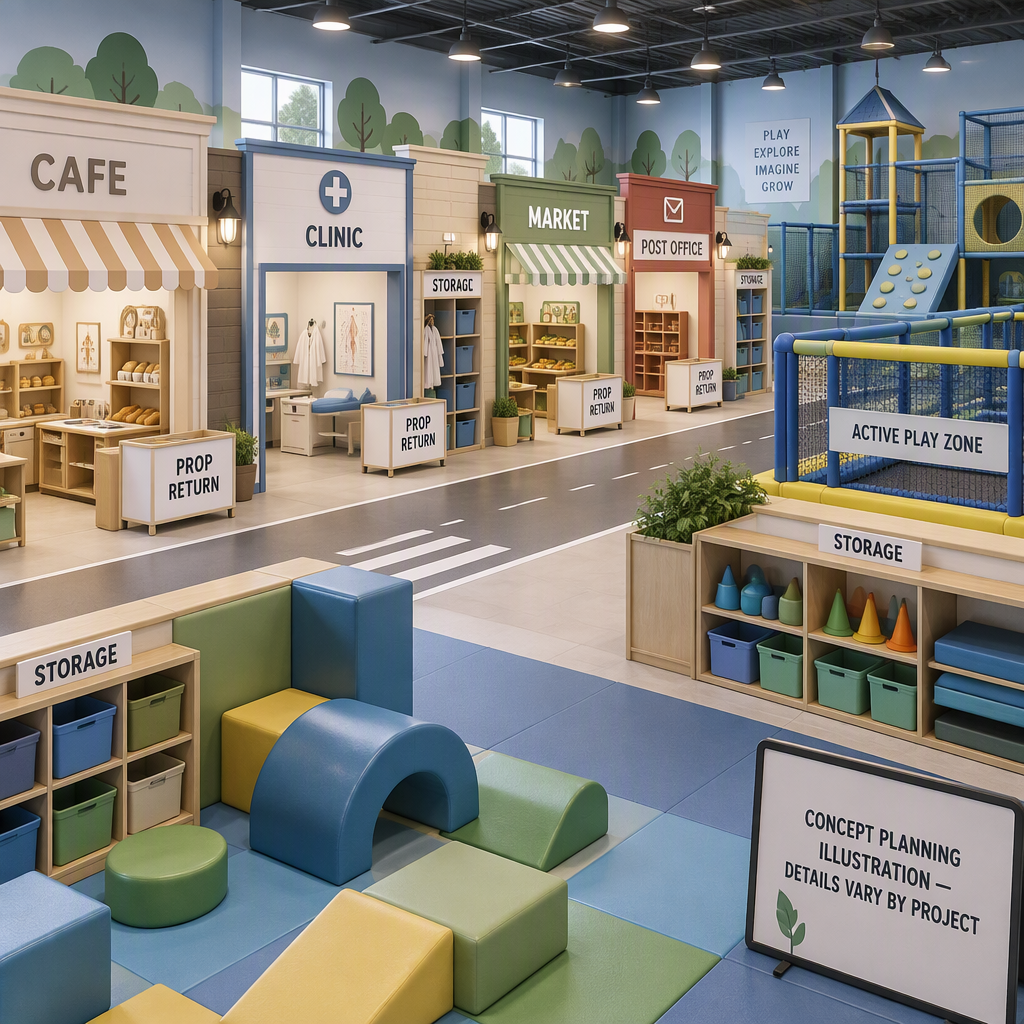
Define what counts as a loose prop before the layout is approved
A loose-prop plan starts by separating movable role-play items from fixed equipment, installed facades, soft play structures and separately operated active zones; only the movable items need the prop-return system, while fixed and active equipment need their own inspection and access controls.
In a city role-play and soft play concept, storefront-style facades, selectable scenes and active play choices can sit close together. The operating problem is not that all items are the same; it is that small movable accessories behave differently from installed play structures, EPP block activities, climbing features, ball play, sand play or trampoline-related areas.
For a buyer, this distinction should be made before layout approval. If the supplier schedule lists scenes, activities, props and quantities, the operator can assign responsibility for what must be returned, what must be stored, and what should not cross into another zone.
Map prop movement before children move between zones
The best way to prevent prop drift is to map the journey of each prop from scene use, to temporary holding, to return, to storage, before the street is connected to slides, ball play, climbing features or jumping activities.
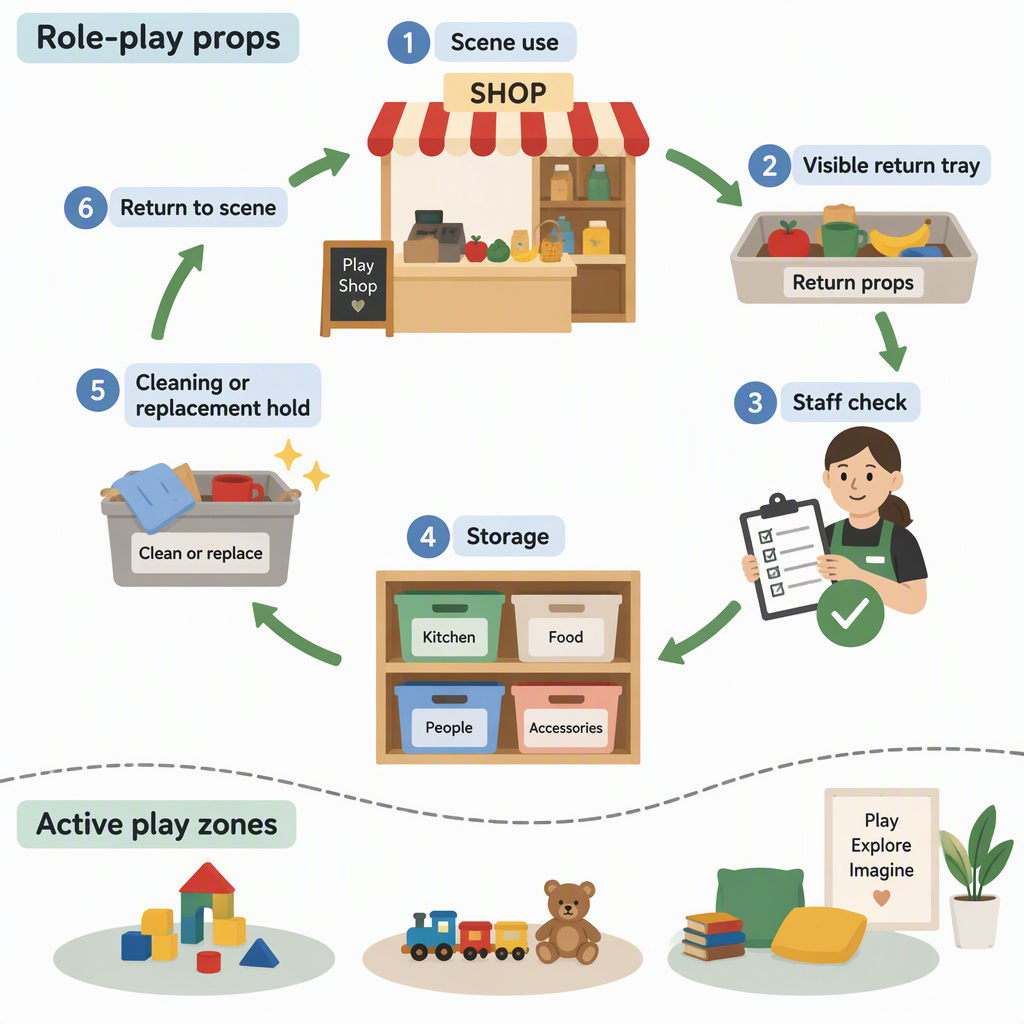
- List the scenes first. Identify each storefront or role-play scene that will receive movable props, such as pretend service counters, mini kitchen play, supermarket play, doctor-themed play, fire-station play or post-office play when those scenes are selected for the project.
- List the movable items separately from the scene name. A scene name does not prove what accessories are supplied. Record the actual props, blocks or loose accessories in the order schedule.
- Draw the normal use area. Mark where children are expected to use the items inside the role-play street rather than beside slide exits, climbing approaches, ball-play edges or trampoline entries.
- Add a return point at the scene. Use a visible shelf, tray, bin or other return position so visitors and staff can recognize where the item belongs.
- Add a staff check point. Decide where missing, damaged, dirty or misplaced items will be held until they are returned, cleaned according to supplier instructions, replaced or removed from play.
- Confirm the storage route. Make sure the back-of-house or closed-period storage path does not require staff to move props through active equipment paths during normal operation.
Choose scene-specific props or a shared prop library
Scene-specific prop sets give operators clearer control, while a shared prop library can add flexibility only if the venue has a staffed issue-and-return point and a visible inventory system.
Commercial buyers often face a choice: should each storefront keep its own items, or should props circulate across the street? Neither model is automatically better. The right choice depends on how much operating control the venue can support and how clearly the prop package is itemized.
| Prop model | Best fit | Operating advantage | Main control issue |
|---|---|---|---|
| Scene-specific sets | Streets with clearly themed storefronts and separate play narratives | Staff can see at a glance when a mini kitchen, supermarket, doctor, fire, post or other selected scene is missing its own accessories | The supplier schedule must show which props belong to which scene |
| Shared prop library | Venues that want props to support multiple role-play stories | Accessories can be rotated or issued for a specific session | The operator needs a staffed issue point, return check and inventory record |
| Limited loose-prop model | Projects where active play is the dominant attraction and role play is a lighter secondary layer | Fewer movable items can reduce the number of objects that must be returned and inspected | The design must avoid making empty storefronts look like fully equipped scenes if props are not included |
Build storage and return points into the operating plan
A workable storage-and-return system gives each scene a labeled home position, a nearby overflow point, a back-of-house storage route and a handover check that confirms missing, damaged or misplaced items before the next operating period.
Storage is not only a furniture question. It affects how the role-play street opens, how staff reset the area, and how easily movable accessories stay out of active equipment paths. The referenced product information supports the need to itemize scenes, activities, props and quantities and to allocate operating arrangements for zones and loose items.
- Scene home position: each movable prop has a normal place within its own scene.
- Visible return point: visitors and staff can identify where a loose item should go without guessing.
- Overflow hold: staff have a temporary place for mixed, damaged, dirty or uncertain items.
- Closed storage: items not in use can be removed from the play floor without crossing active areas unnecessarily.
- Replacement hold: items awaiting replacement or supplier confirmation are separated from play items.
- Opening reset: the team checks that the role-play street starts with the intended items in the intended locations.
- Closing reset: the team confirms what has returned, what is missing and what needs follow-up.
- Start with the supplier’s scene-by-scene item schedule.
- Assign every loose item to one of four statuses: in scene, in return tray, in staff hold, or out of service.
- Mark return points on the floor plan before approving nearby active-play boundaries.
- Decide which items are stored overnight, which remain in the scene, and which require supplier-specific care instructions.
- Use the same names in the layout, operations sheet and procurement schedule so the project team does not rename the same item three different ways.
Coordinate the role-play street with active zones
When a role-play street sits beside active play, the layout should keep prop use areas, slide returns, climbing approaches, ball-play boundaries and any jumping entry separated enough for staff to see where props belong without treating the concept illustration as an engineering drawing.
The related integrated playground page describes a coordinated venue with jungle climbing and slide structure, street-style play facades, a lower activity area and a separate trampoline section. That kind of mixed activity plan makes the interface between quiet role play and active movement especially important.
| Interface | Decision to make | Prop-management implication |
|---|---|---|
| Role-play storefront to soft play | Where does imaginative play end and physical play begin? | Place return points on the role-play side so movable items are not treated as soft-play accessories. |
| Role-play street to climbing or slides | How will children approach and leave active equipment? | Avoid placing loose-prop storage where children naturally move toward climbing or slide activity. |
| Role-play street to ball-play area | Will balls or loose blocks be part of the same story or separate activities? | Separate item categories in the schedule so staff know what belongs to each zone. |
| Role-play street to trampoline section | How will the jumping area be framed as a separate equipment zone? | Do not let role-play accessories enter jumping-related circulation or entry points. |
| Street scene to lower activity area | Will the lower area share props or operate as its own activity? | Use labels and storage rules to prevent mixed inventories at the end of a session. |
Set a daily handover, cleaning and inspection routine
Daily handover should confirm that each delivered prop is present, returned to its scene, suitable for continued use, separated from active equipment paths and assigned to the correct cleaning or replacement process specified for its material and supplier documentation.
Recognized attractions-industry resources can help operators structure safety and preopening-check thinking; for example, IAAPA safety resources include materials for attractions professionals on guest and employee safety topics. That supports using a disciplined handover routine, but it does not replace product-specific instructions, local rules or supplier maintenance guidance.
- Presence: confirm the intended loose items are present according to the project schedule.
- Location: confirm each item is in its assigned scene, return point, staff hold or storage area.
- Condition: remove items that appear damaged, incomplete or unsuitable for continued play until they are reviewed.
- Zone separation: check that loose props have not moved toward climbing, slide, ball-play or trampoline-adjacent interfaces.
- Care route: send items to the cleaning or replacement process stated in supplier or material documentation rather than inventing one on the floor.
- Handover record: note missing, removed or replaced items so the next team starts from the same information.
Turn the prop plan into a procurement brief
Procurement teams should request a layout, scene-by-scene accessory list, storage locations, operating boundaries, supply responsibility and replacement process so the role-play theme, actual supplied props and venue operations stay aligned.
A good brief prevents a common mismatch: the design team imagines a complete city street, the procurement team orders a package, and the operations team later discovers that some accessories, furniture or storage positions were never clearly assigned. For a city role-play concept, the product information supports separating storefront scenes, selected activities, loose items and activity zones rather than treating them as one undifferentiated theme.
- Request the selected role-play scenes and the supplied accessory list for each scene.
- Ask which items are fixed equipment, which are movable props, and which are venue-supplied furniture or decorations.
- Confirm whether EPP blocks, ball play, climbing features, sand play, rocking equipment, soft play structures or trampoline elements are included in the selected package or handled separately.
- Ask for the planned storage and return positions for loose items.
- Confirm operating boundaries between the role-play street and adjacent active-play zones.
- Ask how replacement or extra prop orders will be identified, named and matched to the original schedule.
- Keep the same item names in the quotation, drawings, operations sheet and opening checklist.
Review the city role-play and soft play concept when preparing the schedule, and use project-specific documents to confirm what is actually included for your venue.
Conclusion
Loose props are manageable when they are specified as part of the venue operating system, not treated as decorative extras after the indoor street is designed.
For commercial indoor playground investors and operators, the key is to connect design, procurement and daily operation. Define what is movable, decide whether props are scene-specific or shared, map the prop-flow loop, place storage and return points, protect interfaces with active play, and keep the handover routine tied to the actual item schedule.
- Specify loose props separately from facades, fixed equipment and active play zones.
- Use return points and staff hold areas to stop accessories drifting across the street.
- Do not assume every illustrated item is supplied unless it appears in the order schedule.
- Keep cleaning, replacement and inspection decisions tied to supplier documentation and applicable local requirements.
FAQs about managing loose props in an indoor role-play street
These answers focus on practical operating decisions and avoid unsupported legal, certification, cleaning-chemistry, capacity, cost or performance claims.
What is a loose prop in a commercial role-play street?
A loose prop is a movable item used in a role-play scene, such as a scene accessory, loose block or small play object, rather than an installed facade, fixed soft-play structure or separately operated active-play feature.
Should props be stored inside each storefront?
They can be stored near the storefront when that supports control and reset, but the brief should also identify overflow, staff-hold and closed storage positions so misplaced or unsuitable items do not remain in circulation.
Can one prop set serve several role-play scenes?
Yes, but a shared set needs a clear issue-and-return process. Without a visible inventory and a staff check, shared props can become difficult to locate, reset and separate from active zones.
How should operators handle props near trampoline or climbing areas?
Treat trampoline, climbing, slide and similar activity areas as separate zones. Keep role-play accessories on the role-play side of the interface and confirm the final boundary through project-specific layout and operating documents.
What should be checked at opening and closing?
Check that the intended items are present, in the right scene or storage position, suitable for continued use, and separated from active equipment paths. Record missing or removed items for the next team.
Can a concept illustration be used as the prop inventory?
No. A concept illustration can help explain the theme, but the working inventory should come from the selected package schedule, accessory list and project documents.
Which cleaning products should be used for loose props?
Use the supplier or material documentation for the specific item and follow the rules that apply in the venue’s market. Do not choose disinfectants, contact times or procedures from a generic article when the prop material and local requirements are not confirmed.
What should procurement confirm before ordering?
Procurement should confirm the selected scenes, movable prop list, fixed equipment list, storage positions, active-zone boundaries, supply responsibilities and replacement naming process before the order is finalized.
