
Cabins and slides
Best when the plan needs a visible destination, a repeatable climb-and-slide loop, and a strong front-facing jungle landmark.

Views: 0 Author: Site Editor Publish Time: 2026-11-07 Origin: Site


For a commercial jungle indoor playground, cabins, nets and soft obstacles should not be chosen as theme decorations first; they should be chosen by the activity job they perform in the layout. Cabins make the route visible, nets and bridges add connected challenge, and soft obstacles expand lower-floor activity variety around the main route.
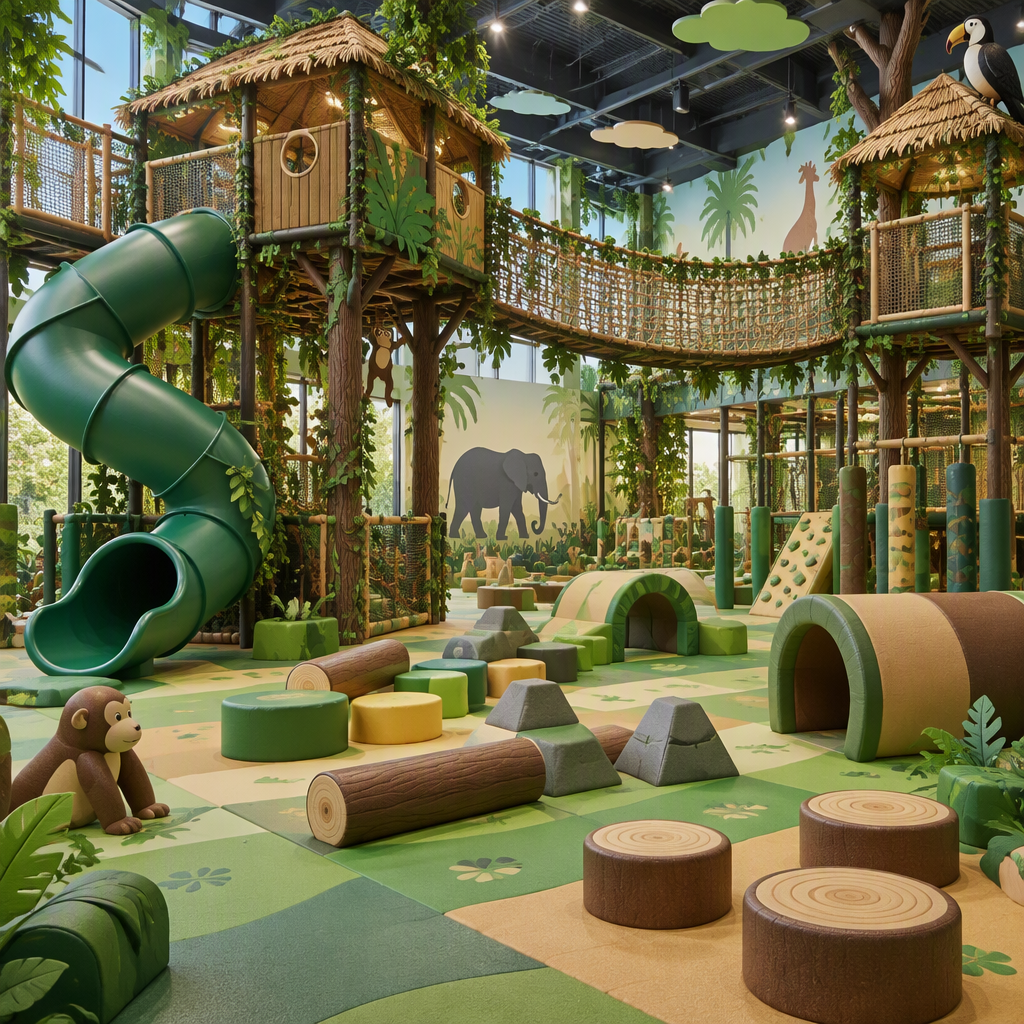
Choose cabins when the venue needs a clear landmark route, nets or bridges when the route needs challenge and connection, and soft obstacles when the lower floor must support mixed activity without forcing every visitor into the raised route.
A jungle theme can make the venue memorable, but commercial planning should start with activity logic. The referenced Vasia jungle concepts describe cabin-style structures, climbing access, slides, selected nets or bridges, enclosed passages and lower soft activity areas as parts that can be arranged into customized routes. Those descriptions support a planning question: what should each element do for the visitor flow and the operator?
A useful jungle indoor playground activity idea is therefore not simply “add more trees” or “add more green parts.” It is a zoned decision: define the main loop, connect the raised route only where it improves movement, and use the lower floor for activity variety, observation and practical access.
Best when the plan needs a visible destination, a repeatable climb-and-slide loop, and a strong front-facing jungle landmark.
Best when raised areas need connection, variety and challenge between structures, while still leaving access for inspection and handover.
Best when lower-floor activity variety, easier circulation and surface access are important parts of the operating plan.
| Lead activity choice | Primary layout job | Good fit when | Approval questions to confirm |
|---|---|---|---|
| Cabin and slide route | Create the recognizable destination and main repeat loop. | The venue needs a clear start, climb path, raised activity point and slide return. | Where are the entrance, slide exit, return path and maintenance access? |
| Nets and bridges | Connect raised areas and add challenge between activity points. | The route needs more variety than a simple climb-and-slide sequence. | Which nets, bridges or obstacles are included, and how are they inspected? |
| Soft obstacle zone | Add lower-floor activity and keep movement readable around the main route. | The venue needs activity points around the slide frontage or enclosed passages. | How will soft contact surfaces be reached for routine cleaning and visual checks? |
A cabin-and-slide layout is strongest when the venue needs a recognizable destination that helps children understand where to climb, where to slide and how to repeat the main loop.
Cabins work well as the “map” of the attraction. In the referenced cabin-slide concept, the jungle structure combines cabin-style forms, climbing access, slides and surrounding floor activities. That makes the cabin more than a decorative hut: it can become the point that tells users where the route begins and where the raised play path is going.
For investors and operators, the cabin choice is most useful when the layout needs a front-facing feature that can be understood quickly from the entrance or parent observation area. It also helps project teams discuss the route with a supplier because the main activity sequence is easier to describe: approach, climb, move through the raised section, slide down, then return or branch into lower soft play.
The Vasia cabin-slide jungle playground page supports claims about the described cabin-style structures, climbing access, slides, surrounding floor activities and listed product-scope construction information for that page. It should not be treated as proof of final site dimensions, local approval, visitor capacity or completed project results.
Nets and bridges work best as connectors or challenge elements inside a raised jungle route, but they require clear access, inspection and handover information rather than generic claims about difficulty or capacity.
Nets and bridges are most valuable when the layout would otherwise feel like separate pieces placed in the same room. A related Vasia jungle slide concept describes selected climbing nets, bridges or obstacles as ways to link raised activity areas within a customized jungle route. That makes them useful between cabins, platforms, enclosed passages or slide approaches.
The main tradeoff is complexity. A net or bridge can make the route more adventurous, but it also creates more connection points to define, inspect and hand over. It should not be added only because the theme is “jungle.” It should solve a route problem: linking two raised points, slowing the path before a slide, or adding a challenge segment that fits the rest of the layout.
Do not use a generic net or bridge description as proof of final difficulty level, user capacity, load rating, age suitability or certification. Those items need project-specific documentation tied to the selected configuration and local review.
Soft obstacles and lower-floor activities are useful when the venue needs activity variety around the main slide route, especially where entry points, returns, adult observation and cleaning access must remain clear.
Soft obstacles help the layout avoid a single-line experience. In the referenced jungle adventure concept, lower soft activity areas sit with elevated adventure elements, enclosed passages, slide forms and floor-level soft play points. That makes the lower zone important for circulation as well as activity variety.
For operators, the lower floor is often where route decisions become visible. Users may enter the main structure, return from the slide, pause near soft forms or move toward another activity. If the soft zone is placed without a clear purpose, it can block the route. If it is planned as a secondary activity area, it can support a smoother relationship between the raised route and the surrounding floor.
Cleaning access should be considered before approval. The CDC’s facility cleaning and disinfection guidance says high-touch surfaces should be cleaned regularly, other surfaces when visibly dirty, and surfaces should be cleaned before sanitizing or disinfecting. That guidance supports the planning principle of reachable high-touch and soft-contact areas, but it does not approve any cleaner for a specific playground material.
General facility cleaning guidance does not establish chemical compatibility for PVC covering, LLDPE parts, EVA flooring, nets or decorative pieces. Confirm approved cleaning methods for the exact selected product scope before operation.
A combined jungle layout should assign one primary route, define separate lower-zone entrances, keep slide exits and returns readable, and leave practical staff access to nets, joints, tubes, soft surfaces and decorative attachments.
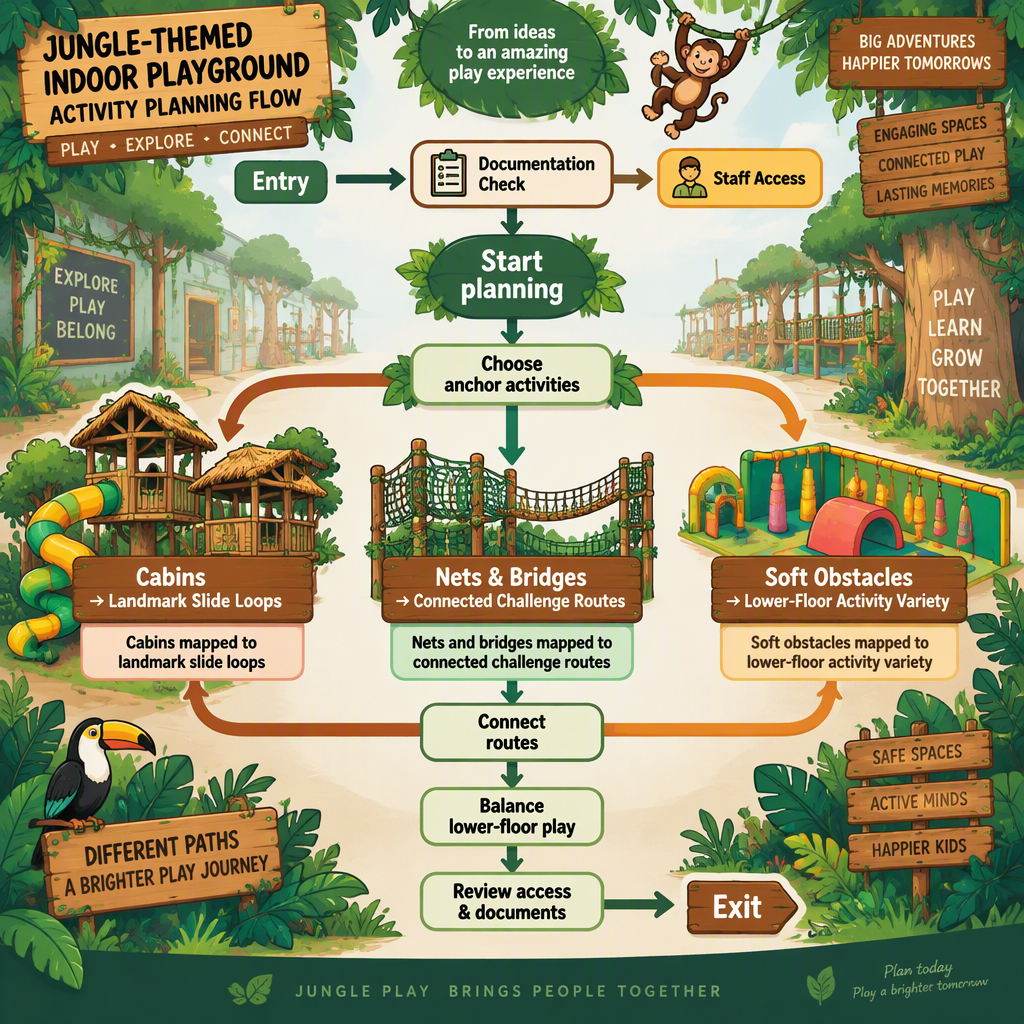
A strong combined plan usually starts with one lead activity, then adds the other elements to support it. If the cabin and slide are the lead, nets and bridges should connect meaningful points rather than create a confusing maze. If the adventure route is the lead, cabins can act as recognizable stations. If lower-floor activity is the lead, soft obstacles should frame the route instead of blocking entry, exit and observation.
| Planning decision | Cabin-led answer | Net or bridge-led answer | Soft-obstacle-led answer |
|---|---|---|---|
| Main route | Make the cabin and slide the obvious loop. | Make the raised connection the main adventure path. | Keep the raised route shorter and support varied lower activity. |
| Lower floor | Use it for return circulation and selected floor activities. | Keep it clear below and around connection points. | Use it as the main activity field with readable entrances. |
| Staff access | Focus on slide exits, cabin access and surrounding soft points. | Focus on nets, bridge joints and raised connection points. | Focus on soft contact surfaces, tube joints and route edges. |
Before approving a jungle playground order, buyers should ask for a zoned layout, itemized component schedule, standards-scope discussion, cleaning and inspection access plan, and a handover package tied to the exact selected configuration.
The procurement risk is not that cabins, nets or soft obstacles are wrong. The risk is approving a visual concept without confirming what is included, how the route works and what information the operating team receives. The referenced Vasia jungle pages can help buyers discuss cabin-and-slide, net-and-bridge and lower soft activity concepts, but final approval should be tied to the selected configuration.
For contextual product review, buyers can compare the specified jungle cabin and slide layout, the related jungle slide and bridge layout, and the jungle adventure and soft play area as examples of different activity emphases. Use those pages as starting points for scope confirmation, not as proof of a finished project requirement.
Product pages can support claims about the described product concepts and listed component information; public-health cleaning guidance can support general cleaning-process planning. Neither source type replaces project-specific approval documents, local requirements, installation drawings or product-specific operating instructions.
The right choice is usually not one element alone: a strong commercial plan uses cabins, nets and soft obstacles only where each element makes the route easier to understand, operate, clean and document.
If the venue needs a visible anchor, lead with the cabin-and-slide loop. If the route needs more connected challenge, add nets or bridges between meaningful raised points. If the venue needs lower-floor variety and practical circulation, give soft obstacles a defined zone instead of treating them as filler.
For commercial approval, the best jungle playground activity ideas are the ones that can be shown on a layout, itemized in the component schedule, checked for access and handed over clearly to the operating team.
These answers focus on activity selection, layout coordination and procurement checks for commercial jungle indoor playground projects.
Not always. Use all three only when each has a clear job: the cabin organizes the main loop, nets or bridges connect raised areas, and soft obstacles add useful lower-floor activity.
Make the cabin the first decision when the venue needs a visible destination, a clear climb-and-slide sequence and a repeat route that is easy to explain on a layout.
No. They add the most value when they connect raised activity areas or create a planned challenge segment. If they do not improve the route, they may add complexity without improving the activity logic.
Soft obstacles can create lower-floor activity variety, but they also affect circulation, observation and access to contact surfaces. Their placement should be reviewed together with cleaning and inspection access.
No. For the referenced product pages, use the pages as support for product-concept and component-scope discussion only. Request product-specific certification, testing or local approval documents separately when those are required for the project.
It should not be used that way. Ask for an itemized schedule that separates cabins, slides, nets, bridges, soft obstacles, flooring, passages and decorations for the selected order scope.
Review the main route, entries, exits, slide returns, lower-zone activity points, staff access, component schedule and any documents needed for local review or handover.
No. General facility guidance supports the sequence of cleaning before sanitizing or disinfecting, but approved cleaning methods must be confirmed for the exact playground materials and components.
