


Define hanging challenges and ground tasks before you sequence them
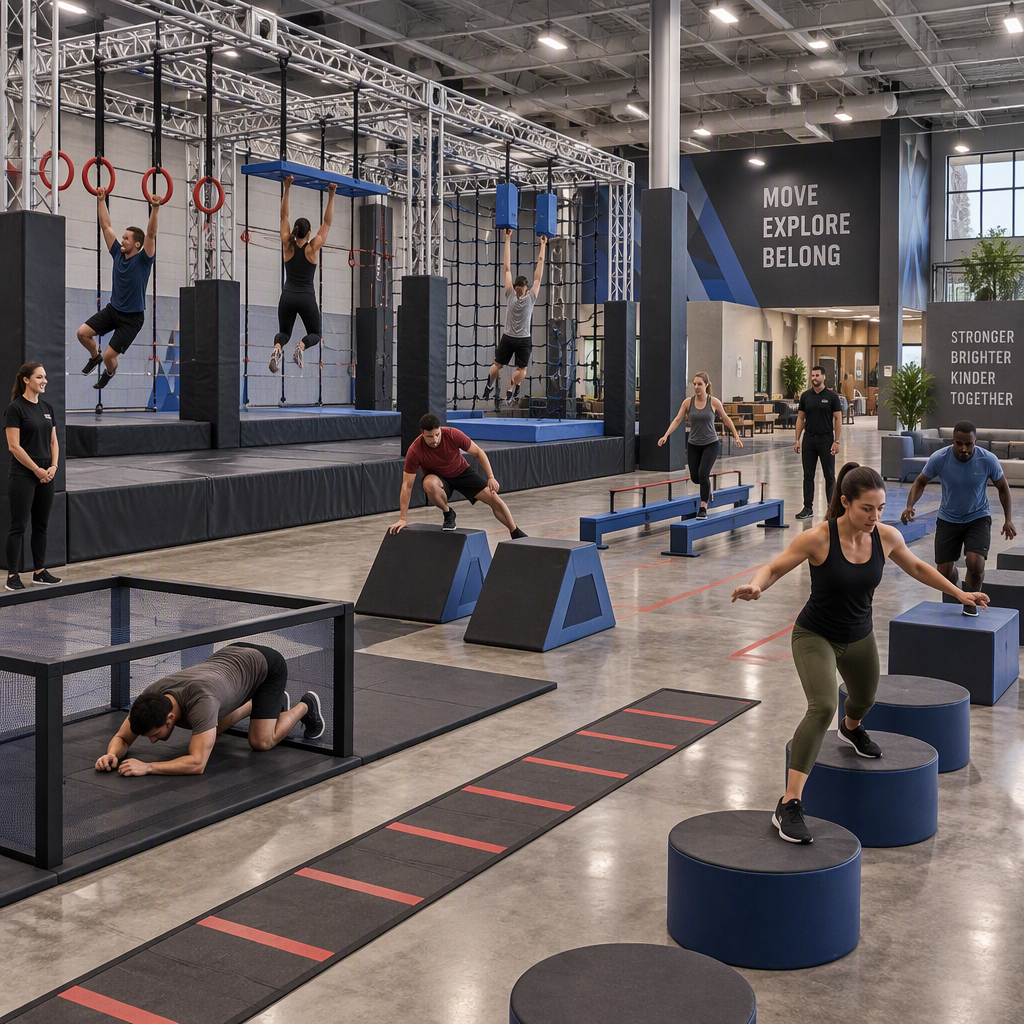
Hanging challenges usually load grip, upper-body control, and transfer timing, while ground tasks usually emphasize running, stepping, jumping, crawling, balance, or obstacle navigation; treat both as planning categories rather than fixed product packages.
A commercial ninja course can combine running, jumping, climbing, and balance tests. The first-party adult ninja obstacle course material also names example obstacles such as swing, cargo net, and monkey bar, which are useful examples for discussing activity types but should not be treated as the confirmed final configuration for every project.
For investors and operators, this distinction matters because sequencing is an operational decision before it is an aesthetic one. The same attraction concept can feel approachable, competitive, congested, or confusing depending on whether the first visible activity is a ground movement, a hanging transfer, a climb, or a balance feature.
| Planning category | Typical movement emphasis | Sequencing implication | Buyer caution |
|---|---|---|---|
| Hanging challenge | Grip, upper-body control, transfer timing, climbing or suspended movement | Can create early excitement, but may fatigue participants or slow first attempts if placed immediately after entry | Do not assume every hanging element belongs to the same standards or operating category |
| Ground task | Running, jumping, stepping, crawling, balance, route navigation, and body control | Often works well as orientation, warm-up, or pacing before more technical challenges | Do not use ground-first sequencing as a substitute for layout review, surfacing review, or supervision planning |
| Hybrid transition | Movement between floor-based and elevated or suspended elements | Useful for changing intensity, separating queues, or creating spectator interest | Confirm the final component list, landing areas, exits, and maintenance access per project |
Because indoor ninja courses may be customized for different commercial venue contexts, the sequence should be developed from the actual venue brief rather than copied from a generic obstacle list.
Choose hanging-first, ground-first, or alternating order by venue goal
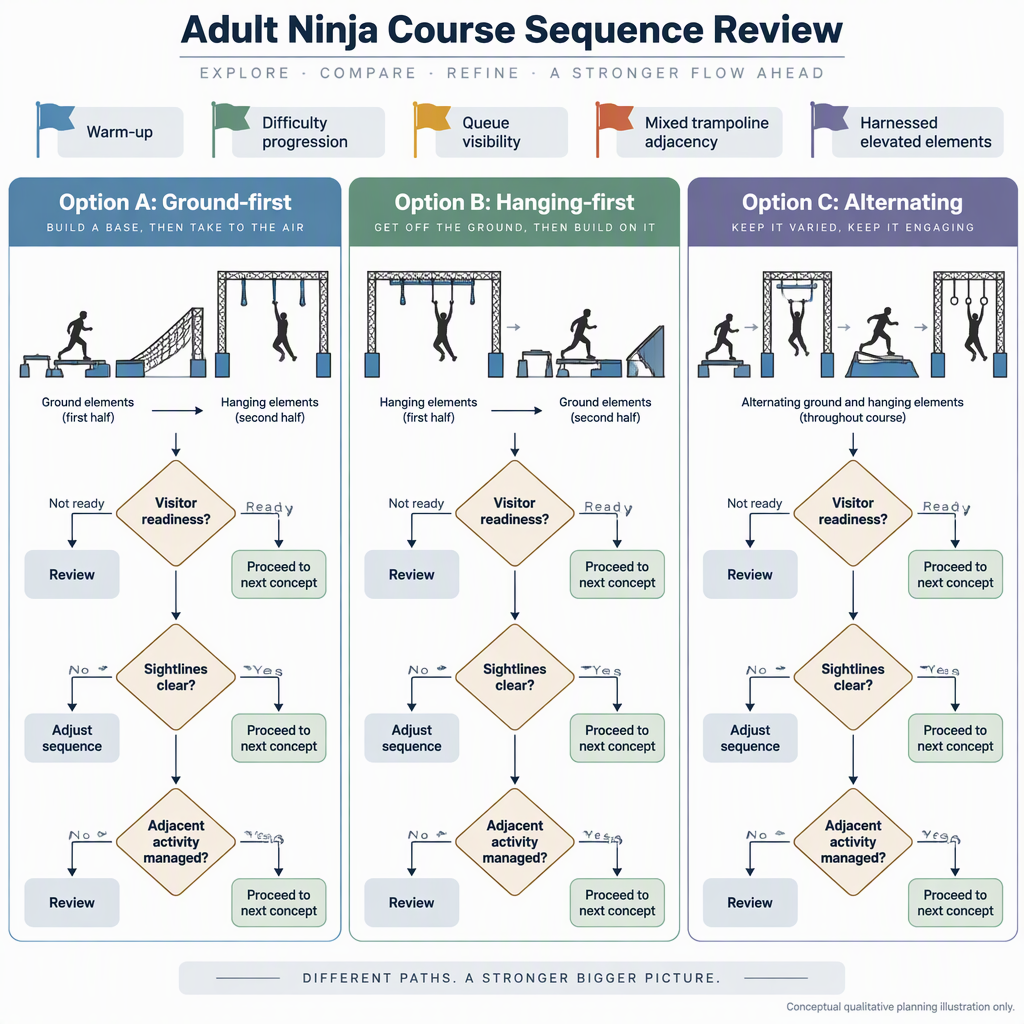
Start with ground tasks when the venue needs an easier warm-up, clearer first-attempt success, or smoother entry flow; start with hanging challenges only when the target audience, supervision model, and landing or exit planning support a faster move into upper-body difficulty.
The sequence should support how adults approach the attraction. Some visitors will enter confidently and look for a demanding challenge. Others may watch first, test a simple movement, or need a visible route before committing. IAAPA frames attractions safety as a shared responsibility across operators, vendors, and attractions professionals, which makes sequencing part of the broader operating plan rather than a product-only choice.
| Sequencing model | Best-fit venue goal | Operational advantage | Risk to review before approval |
|---|---|---|---|
| Ground-first | Make the start intuitive, support warm-up, and reduce hesitation at entry | Participants can understand direction, test balance or movement, and progress toward harder tasks | The opening must still feel interesting enough for adult users and should not create a slow observation cluster |
| Hanging-first | Create an immediate signature moment for a confident adult audience | The attraction communicates challenge quickly and can be visually engaging from the start | Early grip fatigue, failed first attempts, queuing at the entry, landing zones, and supervision sightlines need review |
| Alternating sequence | Balance intensity and pacing across a longer or more varied course | Ground tasks can separate hanging segments and give users a clearer rhythm | Transitions must be obvious so users do not cross traffic, skip into another route, or block the next obstacle |
A practical adult ninja course layout often benefits from an opening that communicates the rules of movement. If the first challenge is too complex, new users may pause for too long. If the first challenge is too easy or visually weak, the course may not signal an adult-level experience. The buyer’s task is to choose the first impression that fits the intended audience and venue format.
Build difficulty progression instead of stacking hard obstacles together
A strong adult ninja sequence normally increases demand in layers: orientation, confidence-building movement, technical challenge, peak challenge, and a clear finish or bypass path; exact intensity and bypass rules need project-specific design review.
Because the adult ninja concept can include running, jumping, climbing, balance tests, and example suspended or climbing obstacles, difficulty does not come from one feature alone. Difficulty can rise through height perception, grip demand, timing, balance, route complexity, fatigue, or the pressure of being watched by other guests.
- Open with orientation. Let the first segment show direction, entry behavior, and the general movement style before the route becomes technically demanding.
- Add confidence-building movement. Use a task that adults can understand quickly, such as floor-based movement or a simple transition, before introducing a high-failure challenge.
- Introduce technical variety. Combine movement categories so the course does not become only grip, only balance, or only running.
- Place the peak challenge deliberately. A demanding hanging, climbing, or balance segment may work better after users understand the route, but it must not block circulation for everyone behind it.
- Design a finish and recovery point. The end of the route should make it clear where users exit, watch, retry, or return to the surrounding venue.
This staged approach also helps the operations team discuss supervision. A course that puts several demanding or failure-prone obstacles back to back can concentrate attention in one area. A course that alternates movement types can distribute user effort, but only if transitions and viewing areas are clear.
For procurement, difficulty progression should be described in plain project language: beginner-friendly start, moderate middle section, signature challenge, recovery area, and exit relationship to the venue. That brief is more useful than simply asking for “more obstacles” or “harder obstacles.”
Plan queues, supervision, exits, and maintenance access around the sequence
Traffic flow should be planned as part of the activity order because bottlenecks often occur where participants stop, watch, fall, retry, or change direction; without site drawings, a buyer can identify coordination points but should not prescribe dimensions from a generic article.
Commercial operators should review the adult ninja route as an operating system: entry, queue, first attempt, failed attempt, bypass, spectator viewing, staff observation, maintenance access, and exit. IAAPA’s safety framing supports the idea that safety and operations planning involves multiple parties, not only the equipment purchase.
- Entry position: confirm whether the first obstacle encourages a clean start or causes participants to gather and watch.
- Queue visibility: make sure waiting users can understand the next movement without stepping into the active path.
- Observation points: identify where staff need line of sight, especially near transitions, landing areas, or repeated failures.
- Exit logic: show how users leave the course after finishing, falling, choosing a bypass, or stopping early.
- Maintenance access: keep inspection and maintenance assumptions separate from guest circulation so that the final design can be reviewed properly.
- Adjacent traffic: check whether trampoline, soft-play, party-room, café, locker, or reception traffic crosses the course entrance or exit.
Hanging-first layouts deserve particular queue review because an early failure point can stop the line before users have entered the flow of the course. Ground-first layouts deserve review too: a floor-based opening may look simple, but it can still create crossing paths if users return to retry, wait for friends, or step out toward another attraction.
Coordinate the ninja course with trampoline, soft-play, or mixed-activity zones
In mixed venues, the adult ninja course should connect logically with nearby trampoline, soft-play, rope, or FEC areas without assuming that one standard or operating model covers every attraction; trampoline-court elements and harnessed aerial elements have separate review boundaries.
The indoor ninja course category is presented for commercial venue contexts such as family entertainment centers, malls, recreational centers, and gyms. In those settings, the ninja sequence has to work not only inside its own footprint but also at the boundary with surrounding activities.
| Adjacent zone | Sequencing concern | Review boundary |
|---|---|---|
| Trampoline park or trampoline-court area | Users may move between jumping, foam-pit, or court-adjacent activities and ninja obstacles | ASTM lists ASTM F2970-25 as active for commercial or institutional trampoline courts within its stated scope; it should be checked when trampoline-court elements are part of the design |
| Soft-play or younger-user area | Adult challenge routing should not confuse guest groups or imply that all areas share the same user profile | Separate the adult route, viewing areas, and age or access assumptions according to the venue’s operating plan |
| Harnessed elevated or aerial-adventure element | Harnessed height activities are not the same as ordinary ground-based or unharnessed ninja tasks | ASTM lists ASTM F2959-26A as active for aerial adventure courses where patrons are required to use a harness to prevent or control a fall from height |
| General FEC circulation | Reception, café, party rooms, lockers, and viewing zones may influence where the course should start or finish | Coordinate attraction sequencing with the whole venue safety and operations plan |
Standards scope should be read narrowly. ASTM’s public page for F2970-25 identifies a trampoline-court scope, while ASTM’s public page for F2959-26A identifies a harnessed aerial-adventure-course scope. Those pages help define review boundaries, but they do not prove that a specific adult ninja course product or final venue layout is certified.
For mixed-activity venues, a good sequence often considers attraction adjacency before obstacle order. For example, a high-energy trampoline boundary may call for a clearer transition into the ninja course, while a calmer surrounding area may allow the ninja entry to become the visual anchor. The right decision depends on the actual venue map and operating model.
Check standards and risk boundaries before treating the layout as final
Before finalizing the sequence, separate general attractions safety planning, trampoline-court scope, harnessed aerial-adventure scope, local requirements, and supplier documentation; none of these should be treated as automatic proof that a specific product is certified.
A sequencing decision should be reviewed through the venue’s safety and operations process. IAAPA’s safety resources frame safety as a shared responsibility across attractions stakeholders and point operators toward education, best practices, standards bodies, and safety culture.
Use public standards pages to understand scope, not to create unsupported compliance claims. ASTM identifies F2970-25 as active for trampoline courts in amusement, entertainment, or recreational facilities, and identifies F2959-26A as active for harnessed aerial adventure courses. Those scopes may matter in a mixed venue, but they do not automatically govern every ground-based or unharnessed ninja obstacle.
- General safety planning: document how the sequence affects supervision, guest instruction, entry, exit, and response to failed attempts.
- Trampoline boundary: if the design includes trampoline-court elements or trampoline-park interfaces, check the applicable trampoline-court standard scope with qualified project advisers.
- Harnessed aerial boundary: if any element requires a harness to prevent or control a fall from height, review the aerial-adventure-course boundary separately.
- Local requirements: confirm building, fire, accessibility, labor, inspection, and operating requirements in the project jurisdiction.
- Supplier documentation: request product-specific drawings, component scope, installation information, inspection guidance, and maintenance instructions before approving a final layout.
- Claim control: do not assume certifications, dimensions, capacity, materials performance, or included decoration unless the supplier provides project-specific documentation.
This boundary work is especially important when a buyer wants one integrated entertainment venue. A single guest journey may pass near trampoline courts, soft-play zones, viewing areas, or harnessed activities, but each part of the venue may have a different review path.
Turn the sequence into a supplier and designer brief
Procurement teams should brief the supplier with venue use case, audience profile, available space, entry and exit assumptions, adjacent attractions, desired challenge level, maintenance access, and any local inspection requirements, while leaving exact engineering dimensions to verified project drawings.
A useful brief does not need to solve the whole layout before the supplier and design team are involved. It should explain what the owner wants the course to do: attract adult users, support a mixed-activity venue, create a visible challenge, manage flow from nearby attractions, or provide a balanced route with hanging and ground tasks.
- Venue type: identify whether the project is a family entertainment center, mall-based venue, recreational center, gym, trampoline park, or mixed-use attraction.
- Target challenge level: state whether the course should open gently, create an immediate signature challenge, or alternate intensity across the route.
- Preferred sequencing model: describe the desired logic as ground-first, hanging-first, or alternating, and explain why that fits the venue.
- Site information: provide available space, ceiling constraints, column positions, entry and exit preferences, surrounding attraction locations, and any known access restrictions.
- Component expectations: separate must-have obstacles from optional examples, and avoid assuming that every example shown on a product page is included in the final scope.
- Operations review: include supervision, guest instruction, queuing, maintenance access, and local inspection assumptions for later validation.
- Product context: review the Ninja Warrior Adult Obstacle Course concept page as a starting point for activity categories, then confirm the final project configuration directly in the layout process.
This approach keeps the procurement discussion practical. Instead of asking only for a catalogue item, the owner gives the supplier enough context to propose a route that fits the project’s users, surrounding attractions, and operating assumptions.
Conclusion
The practical decision is not whether hanging challenges or ground tasks are better, but which order creates a clear, progressive, supervisable adult course for the specific venue and attraction mix.
Use ground tasks first when the course needs orientation, warm-up, and smoother entry behavior. Use hanging challenges first only when the adult audience, staff supervision, landing and exit assumptions, and surrounding layout can support a demanding first impression. Use alternating order when the goal is balanced pacing across different movement categories.
- Define hanging and ground tasks by movement demand before choosing the order.
- Avoid stacking several high-failure or high-fatigue obstacles together without circulation review.
- In mixed venues, review trampoline-court and harnessed aerial boundaries separately when they apply.
- Turn the preferred sequence into a supplier brief that includes venue context, activity mix, entry and exit assumptions, and component expectations.
FAQs
These answers address common commercial planning questions within the limits of product-page evidence, industry safety framing, and public standards-scope information.
Can one adult ninja course sequence work for every venue?
No. The adult ninja concept can combine multiple activity types, and indoor ninja courses may be customized for different commercial venue contexts. A sequence that works in a stand-alone ninja zone may not work beside trampoline courts, soft play, party rooms, or a crowded FEC entrance.
Should adults always start with the hardest obstacle?
Not always. A hard first obstacle can create a dramatic first impression, but it can also create hesitation, failed attempts, and entry congestion. It should be used only when the audience profile and supervision plan support that choice.
When is ground-first sequencing the safer planning choice?
Ground-first sequencing is often the more conservative planning choice when the venue wants clearer orientation, warmer first movement, and a smoother flow into the course. It still needs site-specific review for circulation, supervision, exits, and surrounding traffic.
When does hanging-first sequencing make sense?
Hanging-first sequencing can make sense when the course is aimed at confident adult participants and the operator wants the first feature to communicate challenge immediately. The layout team should review landing areas, failed attempts, queue behavior, and staff visibility before approving it.
Is a trampoline court standard automatically applicable to every adult ninja obstacle course?
No. ASTM identifies F2970-25 as active for commercial or institutional trampoline courts within its stated scope. That scope may matter when trampoline-court elements or interfaces are part of a mixed venue, but it should not be presented as automatically covering every ninja obstacle.
Does an aerial adventure course standard cover all hanging obstacles?
No. ASTM identifies F2959-26A as active for aerial adventure courses where patrons are required to use a harness to prevent or control a fall from height. Ordinary hanging-style ninja challenges should not be treated as harnessed aerial-adventure elements unless the actual design falls within that scope.
What should be confirmed before asking a supplier for a final layout?
Confirm the venue type, target audience, available space, entry and exit preferences, surrounding attractions, desired challenge level, inspection assumptions, and whether the preferred sequence is ground-first, hanging-first, or alternating. The supplier and design team can then develop a project-specific layout for review.
