
Views: 0 Author: Site Editor Publish Time: 2026-08-03 Origin: Site


Transitioning from a standard bounce facility to a profitable Indoor trampoline park requires a strategic mix of attractions. You cannot rely solely on vast square footage of trampolines anymore. Modern consumers demand dynamic, varied experiences. For investors, franchisees, and owner-operators, your equipment choices matter deeply. The decision of what to include directly dictates facility throughput, insurance premiums, and target demographic expansion. If you fail to adapt, you risk rapid customer churn and high liability costs. This guide breaks down the essential equipment categories, compliance requirements, and layout considerations required to build a resilient, high-capacity bounce facility. You will learn how to design layouts tailored for diverse age groups while maximizing safety. Ultimately, this blueprint will help you build a profitable operation that drives repeat visits and aggressively mitigates operational risk.
Legacy park layouts heavily relied on "wall-to-wall" open jump concepts. Today, these older models face steep diminishing returns. A single massive bounce area suffers from lower customer retention. It creates high injury liability because users of different sizes mix freely. Furthermore, it holds limited demographic appeal, largely alienating teenagers and adults who want more engaging challenges.
You can solve this by adopting the Multi-activity trampoline park model. This approach integrates hybrid attractions directly into the floor plan. By adding climbing walls, ninja courses, and gamification elements, you increase average dwell time. Higher dwell time translates to increased per-head spend on food, beverages, and premium attraction upgrades.
How do you evaluate which attractions to include? We recommend analyzing park inclusions based on three strict metrics:
| Business Metric | Legacy "Wall-to-Wall" Concept | Multi-Activity Model |
|---|---|---|
| Target Audience | Mainly children aged 6-12 | Toddlers, teens, adults, and corporate groups |
| Average Dwell Time | 60 to 90 minutes | 120 to 180+ minutes |
| Injury Liability | High (mixed size jumpers) | Low (segmented play zones) |
| Revenue Streams | Ticket sales, basic snacks | Premium tickets, RFID games, robust cafes |
Even as you diversify, classic bounce zones remain the anchor of your facility. Designing them properly ensures continuous flow and minimizes operational headaches.
The main court serves as the primary attraction for most casual visitors. Focus heavily on continuous flow. Avoid placing dead ends where users might collide. Introduce varied launch angles by incorporating angled wall trampolines. Always insist on high-density padding over all exposed springs and frames. A seamless padding system prevents pinched toes and serious impact injuries.
Dodgeball and basketball zones offer massive business value. They boast high social shareability. Teenagers love filming slam dunks for social media. These courts also act as primary drivers for group events and birthday party bookings.
When evaluating these zones, pay close attention to two dimensions:
You must give advanced jumpers a dedicated space. High-performance zones target teens, young adults, and gymnastics enthusiasts. Keep casual jumpers out of this area to prevent severe accidents.
Equipment specifics matter here. Install Olympic-grade netting for superior bounce height. Add walk-the-wall features for parkour enthusiasts. Most importantly, use specialized airbag landings. We strongly advise against outdated foam pits. Foam blocks break down rapidly, create hazardous dust, and harbor dangerous bacteria. Airbags reduce liability and drastically cut down daily cleaning times.
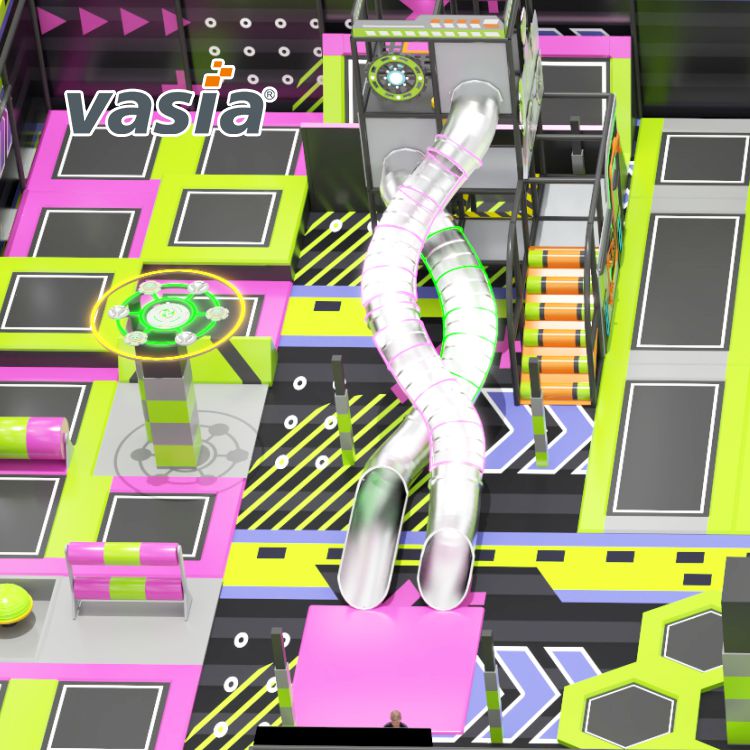
Beyond traditional bouncing, modern parks need hybrid attractions. These features break up the physical intensity of jumping and keep guests entertained longer.
Ninja courses test upper body strength and agility. Their biggest advantage is scalability. You should look for modular designs. Modular trusses allow operators to swap out individual obstacles annually. You can introduce fresh challenges without undergoing a full redesign. This keeps the attraction feeling new for repeat visitors.
Gamification is transforming the active entertainment industry. Linking physical movement to digital outcomes creates addictive gameplay. You can install augmented reality (AR) jump games that project targets onto the jump bed. Timing systems for obstacle courses encourage repetitive play as guests try to beat their high scores. Gamification also opens lucrative upselling opportunities. You can sell branded RFID wristbands so guests can track their global leaderboards.
Constant jumping causes rapid physical fatigue. You need non-bounce anchors to manage overall park stamina. Consider adding indoor climbing walls, mechanical wipeout machines, and zip lines. These attractions balance physical exertion levels. They allow guests to catch their breath while still actively participating in the facility.
Failing to separate age groups is a massive operational mistake. You must design zones specifically tailored for smaller bodies and different play styles.
Combining toddlers with teenagers is a primary driver of insurance claims. A 180-pound teenager landing near a 40-pound toddler creates a dangerous "double bounce" effect. This easily leads to fractured limbs. Mixed-age play also generates negative online reviews from terrified parents. Strict segmentation is not optional; it is a critical safety mandate.
A dedicated Kids trampoline park zone must use appropriate materials. Install low-rebound mats that are gentler on developing joints. Integrate colorful soft-play structures to encourage safe climbing. You can also build enclosed toddler ninja areas. These mini courses let younger kids feel like big kids without the associated risks.
Toddler areas are actually designed for parents. If parents do not feel comfortable, they will not return. Ensure clear, unobstructed sightlines across the entire kids' zone. Place comfortable seating in close proximity to the play structures. Finally, incorporate acoustic dampening materials in the ceiling above this zone. Lowering the decibel level ensures parents feel relaxed during supervision or while catching up on emails.
Building a credible Trampoline Park starts with rigorous safety standards. Do not cut corners during the procurement phase.
Never purchase equipment based solely on aesthetics. You must source equipment that meets or exceeds ASTM International standards. If you operate outside the US, ensure compliance with local equivalents like BSI or EN standards. These frameworks dictate everything from structural steel thickness to the exact overlapping width of protective padding.
Operators face a choice between traditional coiled springs and composite springless technology. Coiled springs offer a lower upfront cost but require frequent replacement as they stretch. Springless technology demands higher initial capital but drastically lowers long-term maintenance labor.
Evaluate your padding carefully. Padding density must be sufficient to absorb falls onto steel frames. Check the vinyl fire ratings to comply with local fire marshal codes. If your building has skylights or large windows, mandate UV-resistant vinyl. Standard vinyl will crack and fade within a year under direct sunlight.
Your maintenance team needs easy access to the equipment underbelly. Ensure your vendor provides smart sub-frame designs. Staff must be able to easily inspect springs, clear dropped items, and replace individual jump beds. They should never have to dismantle entire court sections just to fix one broken spring.
Even the best equipment fails if the park layout is fundamentally flawed. Strategic planning prevents operational disasters.
Carefully map out customer flow before confirming your floor plan. Avoid creating dead zones where foot traffic naturally stops. Chokepoints near entry gates, exit gates, or party rooms cause massive weekend congestion. Ensure wide walkways and clear directional signage to keep crowds moving smoothly.
Do not sign a contract just because a rendering looks impressive. You must audit potential equipment manufacturers rigorously.
A successful park operates as a carefully balanced ecosystem. It requires well-engineered, compliant, and demographically targeted zones. Relying on a giant room of trampolines is a strategy of the past. Today, you must provide diverse, engaging, and highly segmented experiences to capture market share and drive revenue.
A: A minimum viable footprint usually starts around 15,000 to 20,000 square feet. However, highly profitable parks often range from 25,000 to 40,000 square feet. Crucially, you need a minimum ceiling height of 17 to 20 feet from the floor to the lowest hanging obstacle. This ensures clear-space compliance for safe bouncing.
A: Modern airbags are significantly safer and more hygienic than traditional foam pits. Foam blocks degrade quickly, release toxic dust, and hide dangerous bacteria. Airbags provide consistent, predictable impact absorption. They also drastically reduce your operational cleaning costs and lower fire hazards within the facility.
A: High-wear items require frequent attention. Heavy-use jump beds and springs often need replacing every 12 to 24 months, depending on throughput. Padding vinyl may last 2 to 3 years before showing severe wear. Structural steel frames, if properly engineered and maintained, should last the lifetime of the business.
A: Yes, absolutely. A dedicated toddler area is mandatory for liability reduction. Separating small children from teenagers prevents severe "double bounce" injuries. Furthermore, it captures the highly lucrative stay-at-home parent market during slower weekday morning hours, driving consistent year-round revenue.

