
Views: 0 Author: Site Editor Publish Time: 2026-08-17 Origin: Site


In the commercial recreation industry, facility operators constantly balance maximizing throughput and minimizing liability. Safety features represent the absolute foundation of your business viability. They dictate commercial insurance premiums and ensure long-term operational longevity. Over the past decade, modern safety regulations have tightened significantly. Consumer expectations have also shifted dramatically. Parents now demand verifiable safety measures before allowing their children to play.
This new reality raises the baseline for what constitutes a safe Indoor trampoline park. You cannot simply install basic jump beds and open your doors. You must evaluate essential hardware, intelligent layouts, and strict compliance features. We will explore how to assess these crucial elements when shortlisting equipment manufacturers or upgrading an existing facility. You will learn to identify premium safety designs that protect both your patrons and your business.
Equipment quality directly correlates to your facility injury rates. If you cut corners on hardware, you will face frequent incident reports. High injury rates trigger skyrocketing commercial insurance premiums. In severe cases, insurers may revoke your coverage entirely. You must view safety infrastructure as your primary risk management tool. Safe equipment builds customer trust and protects your margins.
Substandard materials severely impact your daily operations. When you use cheap foam or thin netting in a Kids trampoline park, you accelerate material wear. Broken springs and torn pads lead to unexpected operational downtime. This downtime frustrates customers and damages your brand reputation. Furthermore, degraded equipment drastically increases your liability exposure. You cannot afford the legal risks associated with failing hardware.
Investing in premium safety features yields a strong return on investment. High-quality materials boast extended lifespans. They require far fewer replacements over their usage cycle. You benefit from significantly reduced incident reports and lower legal fees. Ultimately, advanced safety infrastructure protects your financial bottom line. It creates a sustainable, secure environment for long-term business growth.
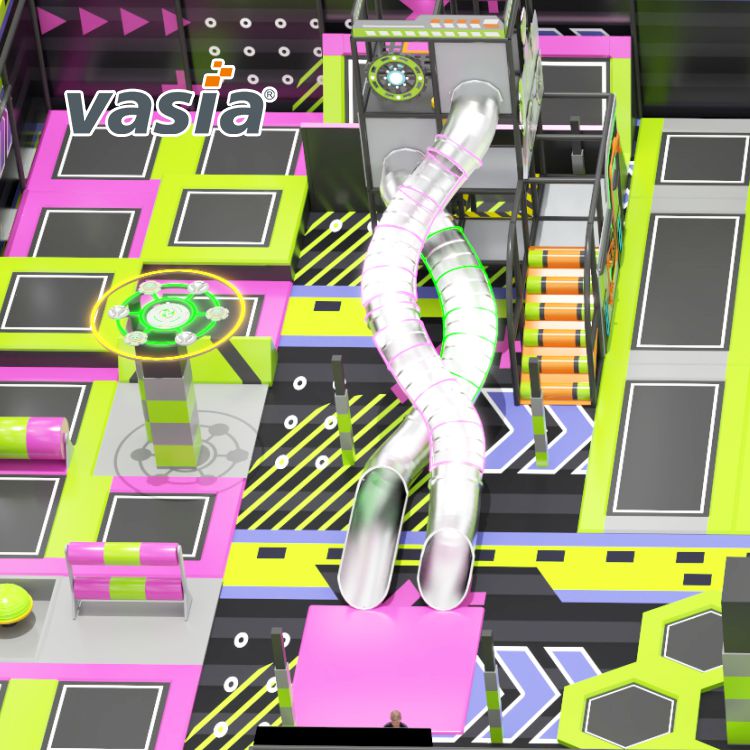
Every Trampoline Park requires specific hardware components to prevent primary impact injuries. You must scrutinize these elements carefully during the procurement process.
You need overlapping, high-density foam padding. This padding must entirely cover all steel frames and exposed springs. Zero-gap designs prevent hands and feet from slipping between jump beds. When evaluating options, check the vinyl cover thickness and tearing resistance. You should also examine the underlying attachment mechanisms. Industrial Velcro systems often outperform structural ties. They maintain tighter seams and prevent the padding from shifting under heavy use.
Structural integrity relies on heavy-gauge, galvanized steel framing. The frame must absorb constant, dynamic loads without buckling. For spring safety, you must prioritize dual-spring systems. Secondary retention mechanisms are also highly effective. These designs prevent a catastrophic bed failure if a single spring snaps during active use. They keep the jumper supported until staff can replace the broken component.
Jump zones require high-tensile, UV-resistant netting. Choose no-climb designs to deter dangerous patron behavior. Installers must anchor these nets securely at both the top and bottom. Tight anchoring prevents jumpers from sliding underneath the net line. We call this dangerous scenario a "submarine" fall. A taut net redirects the jumper safely back into the center of the bed.
Modern facilities are moving away from traditional foam pits. Airbags now dominate the industry for safe impact attenuation. They provide a predictable, uniform landing surface for patrons.
| Feature Evaluation | Modern Airbags | Traditional Foam Pits |
|---|---|---|
| Hygiene and Cleaning | Easy to sanitize daily with standard wipes | Collects dust, skin cells, and bacteria |
| Maintenance Labor | Low (relies on automated inflation blowers) | High (requires frequent block fluffing) |
| Impact Absorption | Consistent and uniform across the surface | Inconsistent (blocks compress and pack down) |
| Replacement Frequency | Every 3 to 5 years depending on traffic | Every 6 to 12 months due to foam tearing |
As you can see, airbags offer superior hygiene and consistent shock absorption. They reduce your daily labor costs while vastly improving jumper safety.
Safety extends far beyond physical materials. Intelligent spatial planning actively prevents accidents before they ever occur. Layout is a critical safety feature.
A successful Multi-activity trampoline park utilizes strict zoning rules. You must use physical barriers to separate high-intensity areas from beginner zones. Keep aggressive dodgeball courts far from toddler jump spaces. Segregating age groups minimizes cross-traffic collisions. It also ensures larger adult patrons do not accidentally injure smaller children. You should map out jumper flow to prevent bottlenecks near court entrances.
Design your floor plan to eliminate all visual blind spots. Court monitors require 100% visibility of active jump zones at all times. Consider equipment height and monitor station placement carefully. Elevated platforms give your staff a comprehensive view of the entire facility. If a monitor cannot see a corner, they cannot stop dangerous behavior there.
Every court must feature clear, unobstructed exit paths. In an emergency, patrons need rapid evacuation routes out of the jump zones. Furthermore, emergency medical personnel must access injured jumpers quickly. Wide walkways and accessible locking gates are mandatory layout features. Do not sacrifice aisle width just to fit in one more trampoline bed.
You cannot rely on verbal safety promises from vendors. Demand documented proof of industry compliance from your equipment partners.
Buyers must look for localized standards based on their region. In the United States, look for ASTM F2970 certification. In the United Kingdom, PAS 5000 is the primary benchmark. Other regions may require specific ISO certifications for structural steel and fabrics. These frameworks define the absolute minimum safety requirements. They are not optional suggestions.
Demand complete transparency from your manufacturers. You should review third-party structural testing reports yourself. Request material fire-retardant certificates for all padding and nets. Ask for detailed load-bearing data for the steel frames. Reputable manufacturers will provide these documents willingly. If a vendor hesitates to share testing data, walk away immediately.
Many manufacturers claim their gear is "built to standards." This phrase is entirely insufficient on its own. You need actual installation schematics and engineered stamped drawings. A stamp from a licensed structural engineer proves the equipment meets local building codes. Without this crucial paperwork, your facility assumes all liability. Regulators will ask for these drawings during your initial building inspection.
Even the highest-quality safety features eventually wear out. You must implement robust operational protocols to maintain your investment over time.
Recognize the expected lifecycle of your materials. High-traffic facilities wear out padding and springs much faster. Jump beds stretch out over time, reducing their bounce profile. You must track average foot traffic to predict when components need replacement. Proactive replacement prevents equipment failure during operating hours. Do not wait for a spring to snap before ordering a new batch.
Safety features fail quickly without standardized checks. You must require a detailed maintenance schedule from your manufacturer. Follow these steps diligently:
Document every single inspection thoroughly. This paper trail protects you against negligence claims if an accident occurs.
Hardware alone cannot guarantee absolute safety. You rely heavily on trained personnel. Staff must enforce capacity limits on each jump court aggressively. They must also enforce safe jumping rules strictly. A well-designed Trampoline park still needs vigilant monitors to manage patron behavior. Invest heavily in scenario-based training for your court monitors.
Selecting the right manufacturer ensures your safety features perform as expected. Use a rigorous shortlisting process to find the best fit.
Evaluate vendors based on their specific hardware innovations. Ask how their designs solve common operational headaches. For example, modular padding systems save significant labor costs. When one pad tears, you replace a small section rather than an entire row. Look for safety features that actively simplify your daily maintenance routine.
Always scrutinize the fine print of equipment warranties. Check what specific types of wear and tear they actually cover. Look for a guaranteed availability of replacement parts. If a specialized spring snaps, you need a replacement shipped immediately. Long lead times mean closed courts, angry customers, and lost daily revenue.
Define your strict safety criteria before requesting a quote. Ask manufacturers for a thorough site evaluation. Review their past installation case studies closely. Look for vendors with pristine safety track records. A reliable partner will guide you through the entire compliance process, from design to final inspection.
Building a secure facility requires a dedicated, multi-layered approach. You must rely on a triad of premium hardware, intelligent layout design, and rigorous operational maintenance. Missing any one of these pillars compromises your entire business structure. Safety is never a one-time purchase.
Evaluating safety features closely at the decision stage is absolutely crucial. Doing this prevents costly retrofits and painful legal liabilities down the road. High-quality materials and strict zoning protect your patrons. They also protect your long-term operational profitability.
Take action today to secure your investment. Request comprehensive compliance documentation from your prospective vendors. Book a structural consultation with a licensed engineer. Finally, download a facility safety evaluation checklist to audit your current blueprints.
A: Industry compliance standards typically require at least 2 inches of high-density shock-absorbing foam. This padding must cover all steel frames and suspension systems completely. The foam should feature a durable vinyl cover to prevent tearing. Zero-gap designs are mandatory to ensure no gaps exist between the jump beds and the protective padding.
A: Yes, airbags offer significant safety advantages. The industry is transitioning toward airbags because they provide consistent, uniform impact absorption. Unlike foam pits, airbags do not compress unevenly or allow patrons to hit the hard floor. They are also far more hygienic and require significantly less daily maintenance labor from your staff.
A: You must inspect safety features daily. Staff should conduct daily visual checks for pad wear and netting tears. You need weekly checks for mechanical tension and spring integrity. Finally, you should schedule comprehensive annual inspections by certified third-party professionals to ensure ongoing structural compliance and safety standards.
A: You should demand verifiable documentation for all regional standards. In the US, ask for ASTM F2970 certification. In Europe and the UK, look for CE marks and PAS 5000 compliance. Additionally, request third-party structural testing reports and fire-retardant certificates for all padding and netting materials to guarantee quality.

