


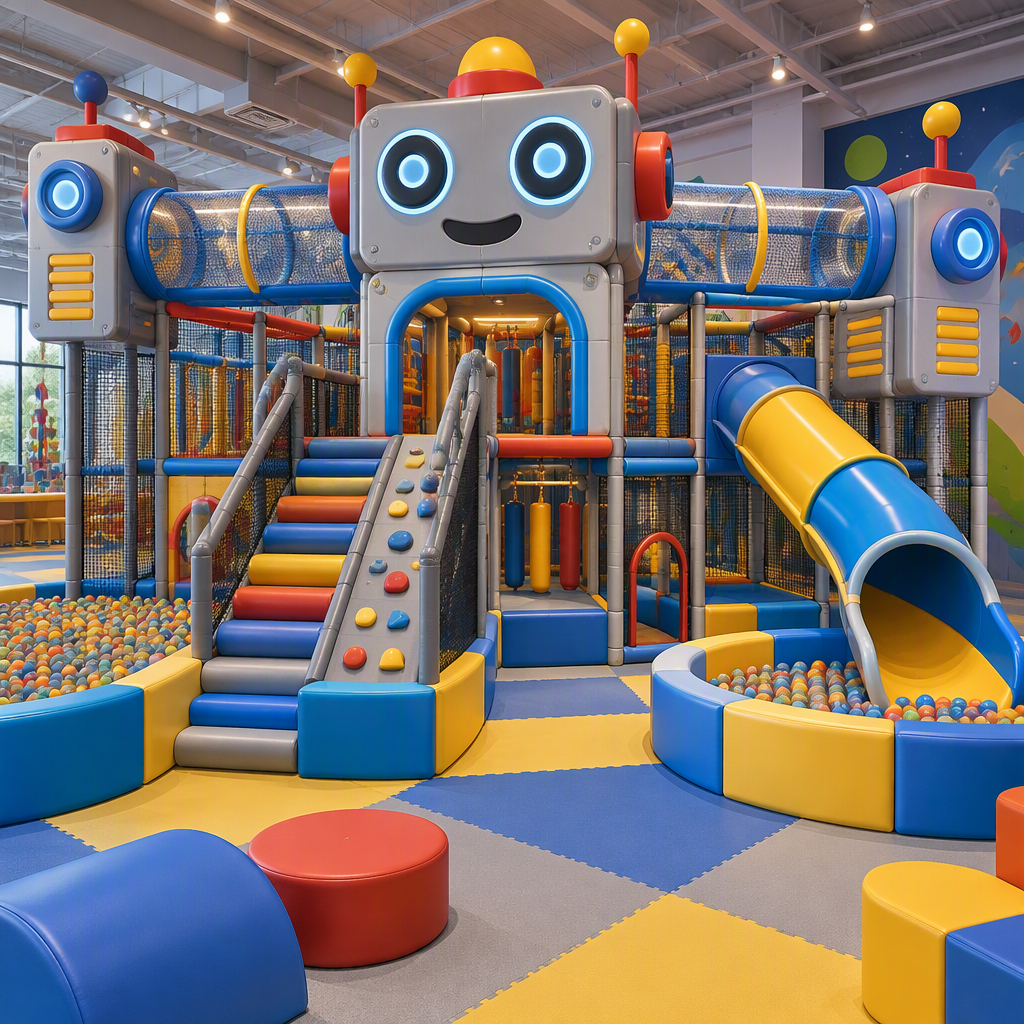
Start With the Movement Route, Not the Robot Graphics
Commercial buyers should choose the core movement sequence before choosing the robot facade because the specified robot-themed product is planned around a customized layout, while soft contained play equipment should be scoped carefully against the applicable equipment category.
For a commercial indoor venue, the most useful planning question is not “How many robot decorations can we add?” It is “What should guests do next?” The product context supports a route that may combine a caterpillar-style tunnel, climbing access, slides and ball play, with the final connections established through the project layout. That means the robot theme should make the sequence easier to read, not cover up unresolved circulation decisions.
- Define the entry experience. Decide where the first crawl, climb or low-level play action begins so the robot frontage points visitors toward an activity rather than a dead decorative face.
- Build a movement chain. Link tunnel play, climbing access, platform arrival, slide descent and ball play as a route where each activity has a visible next step.
- Separate destination zones from passing zones. Ball play can be a destination, while tunnels and climbs usually work better as transitions that move users through the structure.
- Reserve access for staff and maintenance. Enclosed themed sections should remain reachable for inspection, cleaning and operational checks.
- Confirm optional equipment separately. Trampoline areas, electronic buttons, lighting, sound and other powered interactions need their own specification review rather than being assumed as standard theme pieces.
This order of decisions also helps procurement teams avoid overbuying decoration before the activity mix is stable. If a tunnel must connect to a climb, and the climb must feed a slide, the theme designer can frame those points as robot doors, control panels or space graphics without changing the route logic.
How Tunnels, Climbing, Slides and Ball Play Work Together
Tunnels work best as crawling links, climbing works as access toward platforms, slides create the descent, and ball play becomes a lower destination only when slide exits and climbing bases are kept clear and planned for supervision.
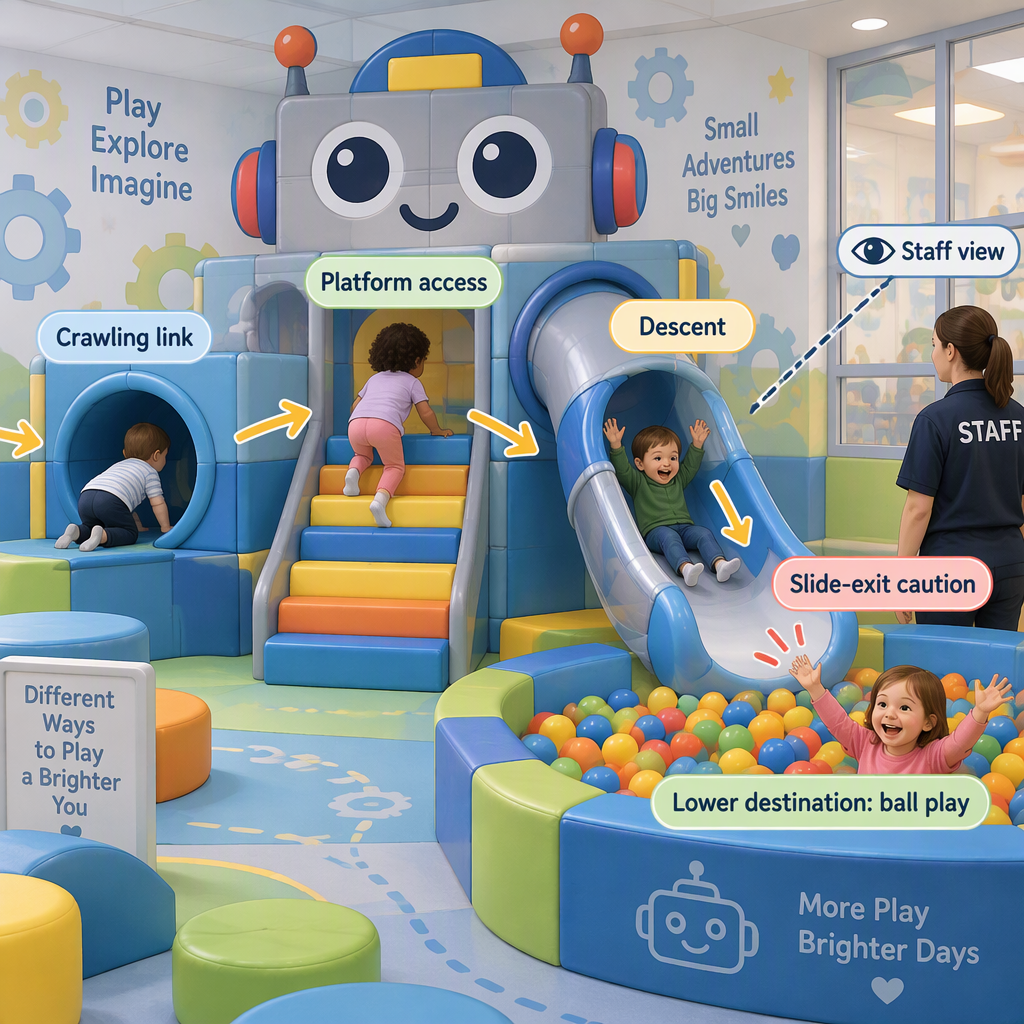
The product page supports a robot-themed playground route that may combine a caterpillar-style tunnel, climbing access, slides and ball play. For a commercial operator, these features should not be selected as isolated attractions. They should be arranged as a sequence that manages excitement, movement direction and operational visibility.
| Activity element | Best planning role | Layout question to resolve | Operational caution |
|---|---|---|---|
| Tunnel | Crawling link between themed zones | Does it lead to an active next point rather than a hidden corner? | Keep both ends visible and reachable for checks. |
| Climbing access | Vertical or inclined transition to platforms | Does the climb connect to a clear destination such as a platform or slide entry? | Plan staff visibility around the base and landing area. |
| Slide | Controlled descent from upper play to lower play | Where does the slide exit, and is that exit protected from congestion? | The CPSC soft contained play equipment checklist highlights the importance of preventing lingering in slide exits. |
| Ball play | Lower destination or soft activity zone | Is it a destination, a slide arrival zone or part of a larger route? | The same CPSC checklist cautions against lingering at the base of climbing equipment in ball pools. |
The practical takeaway is that ball play should not become the place where every route conflict lands. If a slide, a climb and a tunnel all discharge into the same ball area, the project team should review sightlines, exit clearance, staff access and user flow before confirming the layout.
Use Robot Panels to Guide the Route Without Blocking Access
Robot panels should give the playground a recognizable identity while preserving adult sightlines, maintenance access and inspection reach behind or around enclosed sections; decorative coverage should not hide operational needs.
Robot panels and space-inspired graphics can help a venue tell a coherent story. A robot face can mark an entrance, a control-panel graphic can signal a transition, and space graphics can connect different levels of the play structure. These are valuable design tools, but they should be used in service of the activity plan.
- Use theme panels as wayfinding. Place stronger robot visuals at entries, turns and destination points so the route feels intentional.
- Keep sightlines through busy areas. Avoid using decorative coverage where adults and staff need to see slide exits, climb bases and ball-play boundaries.
- Protect inspection access. Enclosed tunnels, nets, webbing and soft surfaces need reachable inspection points.
- Do not hide maintenance routes. Staff should be able to reach areas that collect loose balls, dust or debris.
- Confirm what is theme and what is equipment. Decorative robot panels are not the same as powered buttons, lighting, sound or electronic play devices.
A strong robot-themed playground layout is therefore not the one with the most decorative surface area. It is the one where the theme makes the play route understandable while leaving the operator able to supervise, inspect and clean the system.
Separate Core Soft Play From Optional Interactive or Jumping Zones
Optional trampoline, buttons, lighting, sound or powered interaction should be treated as separate scope items because the product page identifies them as optional or separately specified, and a soft contained play equipment standard should not be stretched to unrelated attraction categories.
Robot themes often invite ideas such as glowing controls, sound effects, mission buttons or a jumping zone. These can be legitimate design discussions, but they should not be assumed to be part of the base soft play package. The product context distinguishes core activity choices from optional trampoline access and separately specified interactive devices.
| Scope item | How to treat it in procurement | Why it matters |
|---|---|---|
| Core crawl, climb, slide and ball play route | Include in the main layout review and activity list. | This is the functional route supported by the product context. |
| Robot panels and space graphics | Confirm as theme elements tied to the route. | They shape identity and wayfinding but should not replace layout decisions. |
| Trampoline or jump feature | Confirm as optional equipment with its own access and operating arrangement. | The product context treats trampoline inclusion as optional rather than automatically part of the soft play route. |
| Buttons, lighting, sound or powered interaction | Request separate specifications, installation needs and service information. | The product context states that these requested devices have separate requirements. |
| Standards and compliance review | Review by equipment type, site and jurisdiction. | ASTM’s public scope information does not certify any specific product or optional attraction. |
Plan Operations Access Before the Venue Opens
A robot-themed soft play layout should include reachable enclosed sections, checkable netting or webbing, clear walkways, protected floor surfaces, managed slide exits and a cleaning plan for high-touch and visibly dirty surfaces.
Operations planning should start before final procurement because access that is easy on a drawing can become difficult after themed panels, tunnels and ball areas are installed. The public CPSC checklist supports attention to inspection topics such as netting, cargo webbing, rope equipment, surfacing, walkways, slide exits and ball-pool areas. The CDC cleaning and disinfecting guidance for facilities supports regular cleaning of high-touch surfaces, cleaning visibly dirty surfaces and cleaning before sanitizing or disinfecting.
- Mark staff access points for tunnels, platforms, ball-play boundaries and enclosed themed zones.
- Confirm how safety netting, webbing, rope elements and surfacing will be checked for tears, frays or visible deterioration.
- Keep walkways and service paths clear so staff can reach the play structure without moving loose equipment.
- Review slide exits and the base of climbing equipment so they do not become unmanaged waiting or lingering areas.
- Plan cleaning around high-touch surfaces and visibly dirty areas, using product-specific material compatibility instructions from the supplier.
- Follow facility-specific regulations, local requirements and the operator’s documented procedures where they apply.
A universal cleaning frequency, chemical choice or inspection interval should not be invented for every robot-themed playground. Those details depend on the materials supplied, the venue’s operating pattern, local rules and the manufacturer’s instructions.
Procurement Checklist for a Robot-Themed Playground Package
A procurement checklist should ask for the agreed route, activity list, theme pieces, optional components, floor and ball-pool scope, access points, cleaning and maintenance information, applicable standards review and installation documentation, without assuming unsupported capacities or certifications.
When a project team is ready to discuss a robot-themed indoor playground layout, the most useful supplier conversation is specific. Ask how the crawl, climb, slide and ball-play sequence will be arranged for the actual venue rather than asking for a generic robot design. Vasia’s broader indoor playground equipment context can support category navigation, but the product-specific page should guide claims about this robot-themed concept.
- Route confirmation: Identify the entrance, tunnel path, climbing access, platform points, slide descent and ball-play destination.
- Activity list: Separate confirmed core activities from optional activities that still need specification.
- Theme package: Confirm which robot panels, space graphics and decorative pieces are included.
- Optional powered items: Request specifications for buttons, sound, lighting or other interactive devices if they are desired.
- Jumping zone scope: Treat trampoline inclusion as optional and confirm access, separation and operating arrangement.
- Access and visibility: Review sightlines, staff reach, service paths and enclosed sections before approval.
- Inspection information: Ask how netting, webbing, rope elements, surfacing, slide exits and ball areas should be checked.
- Cleaning information: Request material-compatible cleaning guidance rather than selecting chemicals or schedules from a generic article.
- Standards review: Confirm which standards, codes or local rules apply to the actual equipment and jurisdiction.
- Documentation: Keep final drawings, component lists, installation instructions and operating documents aligned with the approved layout.
This checklist deliberately avoids unsupported claims about capacity, age range, certification, delivery time, business performance or universal compliance. Those topics require project-specific documents, applicable rules and supplier evidence.
Conclusion
The best robot-themed playground activity mix is the one that turns a clear soft play route into a recognizable themed environment while keeping optional features, inspection access, cleaning needs and standards review visible in the purchase scope.
- Start with movement flow before choosing decorative robot panels.
- Use tunnels as links, climbing as access, slides as descent and ball play as a managed destination.
- Keep slide exits, climb bases, walkways and enclosed areas visible and reachable.
- Treat trampolines and powered interaction as optional items with separate specifications.
- Use standards, regulator guidance, supplier manuals and local review for scope confirmation rather than assuming universal compliance.
FAQs About Robot-Themed Indoor Playground Activities
These answers address practical buyer concerns about route planning, optional scope, operations and evidence limits without adding unsupported claims about certification, capacity, visitor outcomes or financial performance.
What is the main purpose of a tunnel in a robot-themed indoor playground?
A tunnel is best treated as a crawling link between themed zones. In a robot-themed layout, it can feel like a passage through a machine or space module, but it still needs clear entry, exit and staff access in the final design.
Should the ball pool sit directly after the slide?
It can be designed as a lower destination, but the slide exit must be reviewed carefully. CPSC guidance for soft contained play equipment cautions against lingering in slide exits, so the layout should avoid turning the landing area into an unmanaged waiting point.
Can climbing be used as the main transition to upper play?
Yes, climbing access can work as the transition toward platforms when it connects to a clear next activity such as a slide entry or upper crawl route. The exact climbing form, height and suitability need project-specific confirmation.
Can a trampoline be included inside the same robot theme?
A trampoline can be discussed as an optional feature, but it should be scoped separately with its own access and operating arrangement. A soft contained play equipment standard should not be treated as automatic approval for every optional attraction type.
How often should a robot-themed playground be cleaned?
A universal frequency should not be invented. CDC facility guidance supports regular cleaning of high-touch surfaces, cleaning visibly dirty surfaces and cleaning before sanitizing or disinfecting, while exact schedules and chemical choices should follow facility rules, supplier instructions and material compatibility.
Does ASTM F1918-21 prove a specific robot-themed product is compliant?
No. ASTM identifies F1918-21 as an active standard for soft contained play equipment, but a public standard landing page does not certify a specific product, layout or venue. Procurement teams should verify the current applicable edition and request project-specific compliance documents where required.
Can a robot theme guarantee longer visits, higher attendance or better revenue?
No outcome guarantee should be made from the available evidence. Industry benchmark research categories exist, but they do not prove performance results for a specific robot-themed playground, venue or activity mix.
Is a concept activity diagram the same as an engineering drawing?
No. A concept diagram can explain how tunnels, climbing, slides and ball play relate, but installation, clearances, access, materials and operating rules require the final supplier documents and applicable professional review.
