
Free practice
Guests select specific obstacles and may repeat them. The venue must manage waiting positions, failed attempts, exit paths and rejoin points around popular stations.

Views: 0 Author: Site Editor Publish Time: 2026-11-09 Origin: Site


Choose the operating mode before you finalize an adult ninja course. Free practice supports repeated attempts at selected obstacles, a continuous run supports a defined sequence from start to exit, and a hybrid works only when the route, rejoin points, staff procedure and user instructions can change without creating confusion.
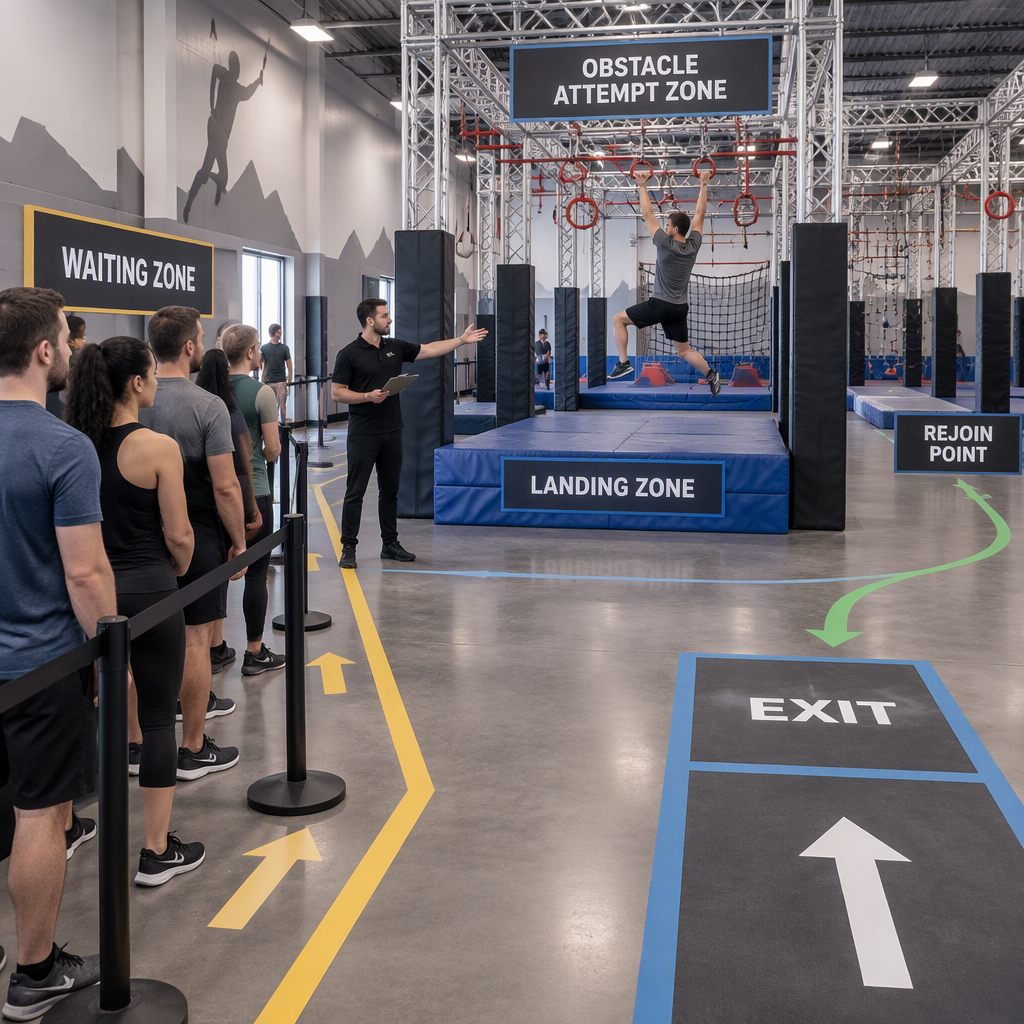
For commercial ninja course operation, the first decision is not which obstacle looks most exciting; it is whether guests will practise individual stations, move through a continuous route, or use a controlled hybrid that changes by session.
The specified adult ninja obstacle course page frames course planning around movement type, route difficulty and obstacle selection, with examples such as swing transfers, cargo nets and monkey bars among a larger set of game concepts. That makes the operating model a design input, not an afterthought.
Guests select specific obstacles and may repeat them. The venue must manage waiting positions, failed attempts, exit paths and rejoin points around popular stations.
Guests follow a planned route from start to finish. The venue must make the route direction, attempt sequence, landing areas, exits and restart logic easy to understand.
The same course supports open practice in some sessions and scheduled runs or races in others. This requires mode-specific staff procedures and preopening checks before the mode changes.
| Planning question | Free practice | Continuous run | Hybrid |
|---|---|---|---|
| Guest intent | Repeat a skill or obstacle. | Complete one defined attempt. | Use different formats by program or time slot. |
| Route logic | Station-based access. | One-way sequence. | Clear switching rules between formats. |
| Main operating risk | Unmanaged clustering at favorite stations. | Confusion after a failed attempt or exit. | Two flow patterns competing in the same space. |
| Best early design question | Where do users wait, retry and leave each station? | Where do users start, land, exit and restart? | How will staff announce, mark and supervise the active mode? |
Free practice and continuous run solve different operating problems: free practice needs managed station access and rejoin points, while a continuous route needs a clear start, direction of travel, landing and exit logic, and staff procedures tied to the sequence.
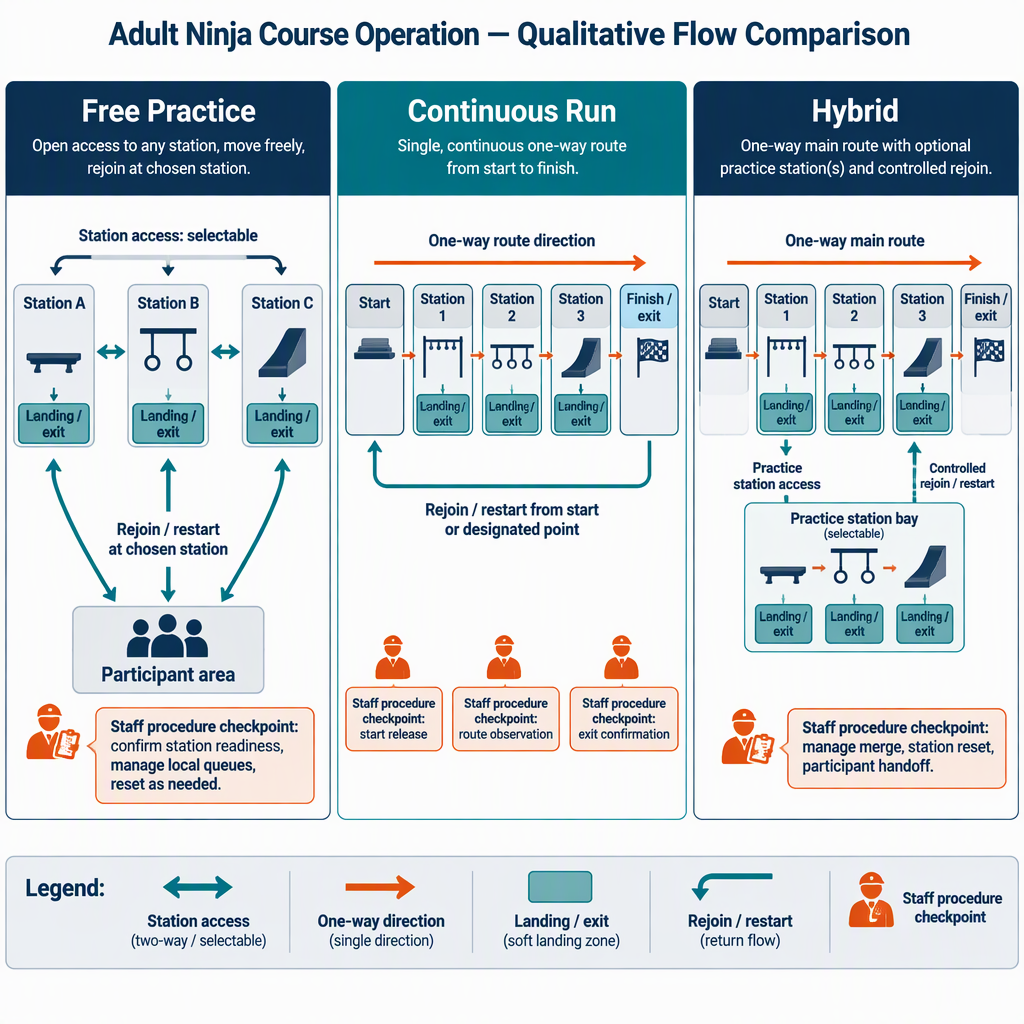
The adult ninja course product page identifies both free-practice and sequential operating choices, and it also notes optional timing or scoring. Timing can support a race-like format, but it should not be treated as a substitute for physical flow planning.
| Operating factor | Free practice emphasis | Continuous run emphasis |
|---|---|---|
| Entry control | Control access to individual stations or zones. | Control release into the start of the route. |
| Failed attempt handling | Define whether the user retries, exits or joins another station. | Define whether the user exits, rejoins at a point, or restarts. |
| Staff communication | Explain station rules, waiting behavior and repeat attempts. | Explain route direction, start signal, missed obstacle procedure and exit. |
| Layout pressure | Popular stations need more visible waiting and exit organization. | The whole route needs a coherent beginning, middle and end. |
| Measurement | Often skill-based or coaching-oriented when used that way. | More compatible with optional timing or scoring when the route is controlled. |
| If your venue priority is... | Lean toward... | Reason |
|---|---|---|
| Skill repetition and coaching-style sessions | Free practice | Guests can return to selected movement types and repeat obstacles, provided waiting and rejoin points are planned. |
| Events, challenges or timed attempts | Continuous run | A defined sequence is easier to align with optional timing or scoring. |
| Different weekday, party, training or event uses | Hybrid | Mode changes need matching staff procedure and preopening confirmation before guests enter the course. |
A free-practice layout should prevent popular obstacles from becoming unmanaged clusters by giving waiting users a dedicated position outside active obstacle and landing areas and by defining how users leave or rejoin each station.
A continuous adult ninja run should be planned as one complete attempt: wait and start, attempt each station, land and leave, then rejoin or restart at a designated point aligned with the travel direction.
Sequential operation puts more pressure on the beginning and end of the route. Users need to know when they are released, where the route goes next, what happens after a missed obstacle, and how they leave the course without crossing the active path.
A hybrid format is practical only when the course can clearly separate open practice from scheduled sequences through signage, staff procedure, route choices and reset or rejoin points, rather than asking the same obstacle space to run two incompatible flows at once.
A hybrid course can be attractive to a mixed-activity venue because adult users may want different experiences at different times. Open sessions may favor practice and coaching. Event sessions may favor a defined route, timed attempt or scored challenge. The design question is whether those experiences can share the same physical course without confusing users.
| Condition | Hybrid may work when... | Hybrid should be reconsidered when... |
|---|---|---|
| Route clarity | The practice stations and sequential route can be explained without contradiction. | The same entry, exit and rejoin points mean different things in each mode. |
| Staff procedure | Staff can run mode-specific guest instructions and checks before changing formats. | Staff must improvise rules while guests are already inside the course. |
| Guest communication | Signs, briefings and barriers make the active mode obvious. | Users can enter a station from the wrong side or merge into a timed route. |
| Programming | Sessions are separated by time, group or supervision plan. | Open practice and timed runs compete simultaneously in the same path. |
Staff procedures should be written around the selected mode because guest instruction, entry control, repeated attempts, failed attempts, rejoin points and preopening checks differ between open practice and sequential operation.
Commercial attractions are operational environments, not only equipment purchases. IAAPA’s education resources and safety resources frame safety, guest experience, employee protection, preopening checks and operations as part of professional attraction management.
Cleaning plans for shared-touch obstacle areas should prioritize regular cleaning of high-touch surfaces, cleaning of visibly dirty surfaces, and cleaning before sanitizing or disinfecting, while leaving chemical compatibility and equipment-specific methods to the product handover documents.
Adult ninja courses include shared-touch components such as grips, ropes, nets and handles, but general hygiene guidance cannot tell you which chemicals are compatible with a specific finish, padding material or attachment. Use the venue hygiene plan together with supplier handover information.
Do not assume one standard covers the whole venue; identify the activity type, component scope, jurisdiction and supplier documentation before applying trampoline, ropes-course, building, fire, accessibility or other requirements to an adult ninja course.
Mixed-activity venues often place ninja obstacles near trampoline courts, soft play, climbing elements or other attractions. That does not mean every rule for one activity automatically governs every component of the site. The practical procurement task is to ask which standards, codes and local authority requirements apply to the selected design and to keep the scope of each requirement clear.
| Venue component | Boundary question | Procurement action |
|---|---|---|
| Adult ninja obstacles | What is the exact route, station list, attachment method and landing arrangement? | Request the station-by-station route proposal and component assumptions. |
| Adjacent trampoline area | Is it a separate attraction with its own operating and inspection requirements? | Confirm the applicable standards and local requirements for that component. |
| Ropes or harnessed elements | Does the selected design actually include ropes-course features? | Confirm the applicable edition and scope before treating it as part of the ninja course. |
| Building and life-safety scope | Do exits, occupancy, fire safety or accessibility rules affect the layout? | Coordinate with qualified local professionals and the authority having jurisdiction. |
Before approving free practice, continuous run or a hybrid, procurement should request a station-by-station route proposal, landing and exit schedule, structural or attachment documentation, inspection-access plan, operating-mode assumptions and any market-specific standards scope.
Vasia’s adult ninja course information points buyers toward movement type, route difficulty, obstacle selection, operating choice and planning inputs such as clear height, columns, walls, doors, overhead services, suspended-element inspection access, grips, ropes, nets, clamps, attachments and the landing system. A procurement brief should turn those points into approval questions before final layout sign-off.
| If the answer is unclear... | Do not approve until you receive... |
|---|---|
| Where users go after a failed attempt | A landing, exit and rejoin explanation for each relevant station. |
| Whether timing or scoring is expected | A route sequence and operating procedure that supports that format. |
| Whether suspended elements can be inspected | Inspection-access information for attachments, grips, ropes, nets and clamps. |
| Whether the concept fits the venue envelope | A review of clear height, columns, walls, doors and overhead services. |
For a supplier discussion, use the adult ninja obstacle course concept page as a starting point for route and operating-mode questions, not as a substitute for final project documentation.
The safest planning answer is conditional: pick free practice for managed skill repetition, continuous run for a defined attempt sequence, and a hybrid only if the physical route, procedures and staff can switch modes without confusing users.
An adult ninja course becomes easier to operate when the business decision is translated into route logic. Free practice is not simply a looser version of a race route; it needs station access, waiting, retry and exit planning. A continuous run is not only a line of obstacles; it needs a start, sequence, missed-attempt procedure and finish. A hybrid is not a universal compromise; it is a controlled change between two modes.
These answers address operating-mode choices for commercial adult ninja courses while avoiding unsupported claims about capacity, certification, pricing, revenue or guaranteed performance.
Neither mode is automatically better. Free practice can support repeated skill attempts, while a continuous run can support a defined sequence. The better choice is the one your layout, staff procedure and guest briefing can control consistently.
Choose a continuous run when you want a clear route from start to finish, especially if optional timing or scoring is part of the program. The route still needs planned landing, exit, rejoin and restart logic.
Yes, if the course is designed and operated as a controlled hybrid. The active mode must be obvious to guests, and staff must have procedures for changing from practice to a sequential route.
No universal number should be assumed from the operating model alone. Capacity depends on the final layout, obstacles, supervision plan, local requirements and supplier documentation.
Timing or scoring is optional. It may fit a continuous route or scheduled challenge, but it is not required for every free-practice or hybrid operation.
Prioritize high-touch shared surfaces, clean visibly dirty areas, and clean before sanitizing or disinfecting. Confirm product-specific chemical compatibility through the equipment documentation.
No. Buyers should request the actual certificate, standard scope, edition, testing or inspection record, and market applicability before relying on a certification claim.
Send the intended operating mode, venue drawings, clear height, columns, walls, doors, overhead services, preferred obstacle types, inspection-access constraints and any local approval requirements.
