


A mixed role-play and jungle adventure playground works best when the venue is planned as one connected guest experience but purchased as clearly separated equipment groups: jungle movement, street play, lower activity, jumping or netted activities, and shared circulation. The important decision is not whether the ideas can sit in one indoor playground; it is how each zone earns its place, how visitors move between zones, and how the supplier’s item schedule matches the operator’s expectations.
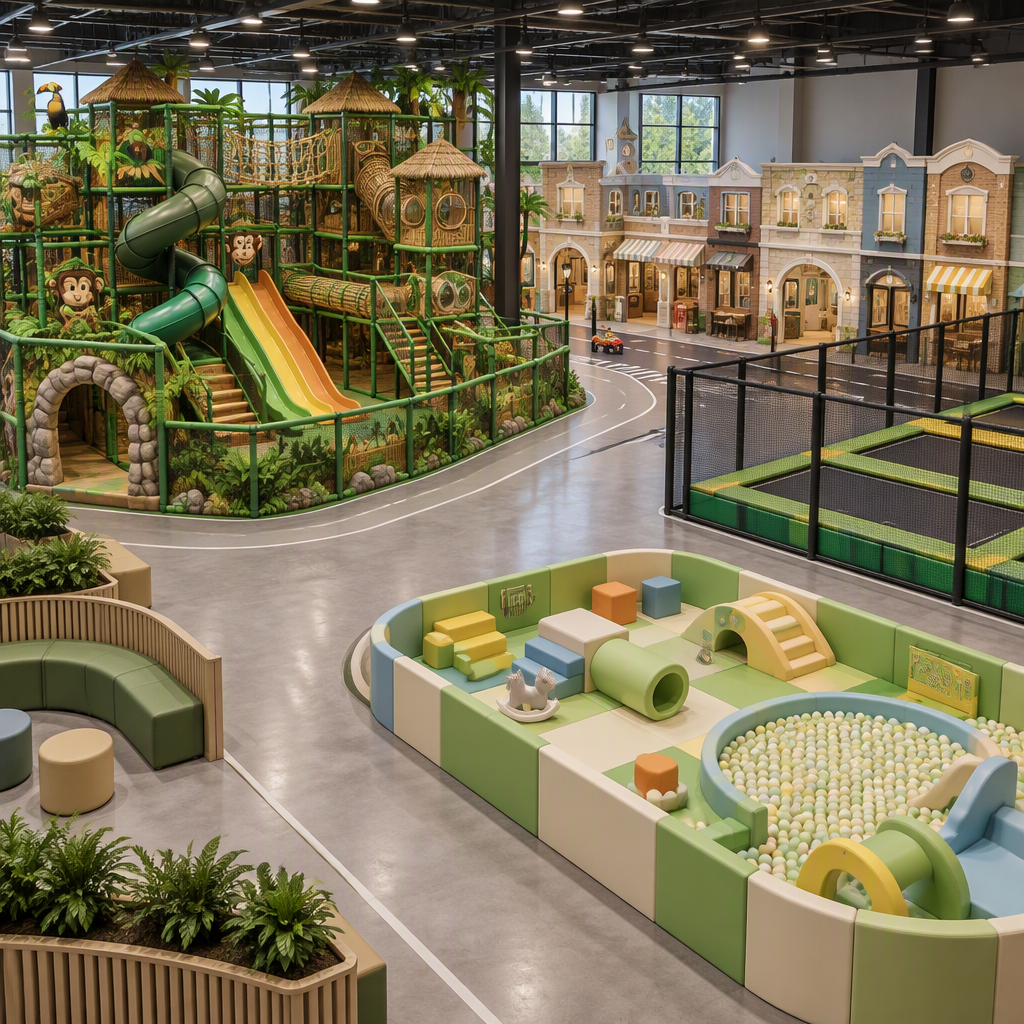
For a commercial buyer, the strongest brief treats the theme as a planning language, not as a substitute for procurement detail. A jungle facade, a street-play storefront, a slide tower, a trampoline section, a netted area, floor mats, pads and loose accessories can all affect scope in different ways. Those elements should be separated in the layout package and quotation so the project team can confirm what is supplied, what is optional, and what is part of venue decoration or later operations.
Start with the venue concept, not separate equipment lists
Start by deciding which zone is the main reason to visit, then let the other zones support that attraction instead of competing for the same floor area, entry route and staff attention.
A role play and adventure playground can fail at the planning stage when every activity is treated as equally central. Jungle climbing, slides, street-style role play, a lower activity area, a trampoline section and a netted area can belong to one concept, but they should not all try to serve the same purpose. One zone normally sets the promise of the venue, while the other zones add variety, extend the activity journey, or support a different activity pace.
In a jungle-and-street-play layout, the investor should first define the lead attraction in plain operating language. If the goal is an adventure-led venue, the jungle structure and slide routes become the anchor, while the street-play area gives children a slower imaginative break. If the goal is an imaginative city-play venue with active add-ons, the street facades and small-world play set the identity, while climbing and sliding provide physical variety. If jumping or a netted activity is important, it should still be planned as a separated activity rather than being absorbed into the soft-play route.
| Concept priority | Best planning use | What to protect in the layout | Procurement implication |
|---|---|---|---|
| Jungle adventure leads | Use climbing, raised routes and slides as the main activity journey. | Clear approaches to entries and exits for the adventure structure. | Separate the structural play scope from themed decoration and loose accessories. |
| Street role play leads | Use storefronts, facades and city-play scenes as the identity of the venue. | Enough calm activity space around role-play units so they are not treated as corridors. | List furniture, props and miniature vehicles separately from fixed facades. |
| Mixed soft play leads | Use lower activity, climbing and imaginative play as a balanced family of zones. | Readable transitions between fast and slow activities. | Request itemized schedules for pads, mats, plastic components and activity modules. |
| Jumping or netted activity supports the concept | Add a higher-energy zone without making it the path through the whole venue. | Separate entry, boundary and instructions for the activity. | Treat trampoline or netted components as their own equipment group. |
Give every zone a different job
Each area should have a defined commercial and operational job: jungle play carries raised movement and slides, street play supports imaginative role play, lower equipment serves a different scale of activity, and jumping or netted areas need their own boundaries and instructions.
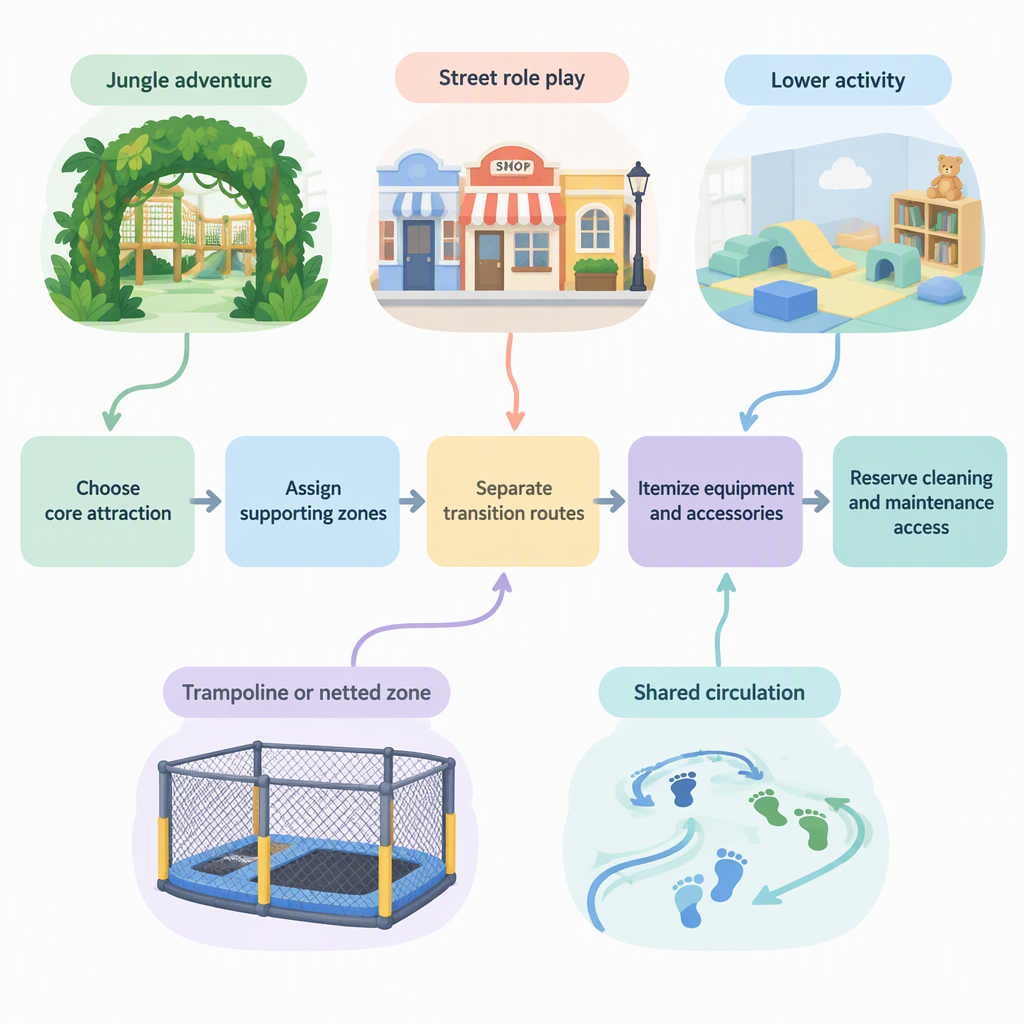
A practical mixed layout assigns each zone a role before discussing finishes or colors. The specified integrated playground concept includes a jungle climbing-and-slide structure, street-style play facades, a lower activity area, a separate trampoline section and an additional netted area. Those zones are easier to coordinate when the buyer asks what each one does for the venue, what equipment group it belongs to, and what questions must be answered before ordering.
| Zone | Primary job | Planning question | Scope note |
|---|---|---|---|
| Jungle climbing and slides | Create the main adventure route and visible movement. | Where do children enter, climb, descend and leave the activity route? | Confirm frame, plastic components, pads and slide-related items in the equipment schedule. |
| Street role play | Support imaginative play and provide theme identity. | Are facades only visual, or do they include interior activity pieces? | Itemize storefronts, furniture, props and any miniature vehicles separately. |
| Lower activity area | Offer activity at a different scale and pace from raised routes. | How does this area connect without becoming a traffic shortcut? | Confirm mats, padding, small equipment and boundaries by item. |
| Trampoline section | Add a distinct jumping activity. | How is the entry controlled and separated from circulation? | Request separate trampoline component and operating-instruction schedules. |
| Netted area | Add an enclosed or bounded activity area. | What is the boundary, entry point and maintenance access? | List nets, support elements, pads and access points separately. |
| Shared circulation | Connect zones without turning active surfaces into corridors. | Can visitors understand where to move next? | Show routes separately from equipment footprints in the layout package. |
This approach helps the buyer prevent two common procurement mistakes. The first is overloading the floor with attractions that do not have clear jobs. The second is approving a strong theme without confirming which visible details belong to the supplied equipment package. A zone-role table gives designers, procurement teams and operators a shared vocabulary before detailed drawings are finalized.
Plan transitions before fixing the play mix
Transitions should be planned as deliberate routes between activities, not leftover space between structures, because children need understandable ways to leave role play, approach jungle routes and enter any jumping or netted activity without crossing active landing or bounce areas.
The most important layout conversation is often not the equipment itself, but the space between equipment groups. In a mixed role-play and adventure concept, children may shift from a calm street-play activity to a raised jungle route, from a slide exit to another soft-play element, or from a walking route toward a trampoline or netted zone. If those transitions are not planned early, the venue can become difficult to supervise and confusing to operate.
- Mark the lead activity first. Decide whether jungle adventure, street role play or another zone anchors the visit, then place supporting activities around that route.
- Separate entries from exits. Show how a child approaches each activity and how the child leaves it before another group enters the same space.
- Keep active areas from becoming shortcuts. Do not rely on slide exits, bounce surfaces or netted activity entries as general circulation.
- Plan calm-to-active transitions. Street-play areas and lower activity zones often work best when visitors can move toward more active zones intentionally rather than being pushed into them by crowd flow.
- Reserve review points for the operator. Before approval, ask the project team to identify supervision positions, service access and any areas where staff may need direct visibility or physical access.
A useful transition review is simple: follow a child’s likely path from arrival to the first attraction, from the first attraction to the next, and from each active zone back to circulation. If the route depends on crossing another activity surface, squeezing behind a facade or passing through an equipment-service area, the layout should be reconsidered before the equipment list is frozen.
Separate theme appearance from supplied activity scope
Treat theme facades, internal furniture, loose role-play props, miniature vehicles, nets, pads, trampoline components and floor mats as separate scope items so the quotation matches what the operator expects to install, clean, inspect and replace.
The specified integrated playground page supports a coordinated jungle-and-street-play concept, and it also lists material and equipment details such as a play-structure frame, plastic components, covered padding, EVA mats by order, customized layout support and CAD or assembly guidance. That is helpful for buyers, but it also makes scope discipline essential: a buyer should not assume that every themed or movable detail visible in a concept is automatically included unless it is listed in the order schedule.
- Ask for a zone-by-zone equipment schedule rather than a single combined description.
- Separate fixed play structures from decorative facades and venue build-out items.
- List loose role-play accessories, furniture and miniature vehicles as counted items if they are expected.
- Confirm whether mats, pads, nets and boundary elements are included, optional or site-specific.
- Request separate schedules for trampoline-related components and any netted activity area.
- Identify which items require product-specific cleaning, inspection or replacement instructions.
- Keep the final approved renderings, plan drawings and item schedules aligned before order confirmation.
The buyer can use the integrated indoor playground product page as a starting point for discussing the jungle structure, street-play appearance, lower activity area, trampoline section and netted area, but the purchase decision should still rely on a confirmed item schedule for the exact project.
This distinction is especially important for role play. A storefront facade may create the city theme, but the business value of that area depends on what children can actually do there. If the expected activity depends on counters, seats, props, miniature cars or other loose items, those details need to appear in the supplier discussion. The same logic applies to jungle adventure: visible slides and climbing routes are different from frame specifications, pads, surface coverings, mats and installation guidance.
Build operations into the layout before ordering
The layout should reserve space and access for supervision, cleaning, inspection and maintenance before the order is approved, because operations requirements affect where routes, entrances, accessories and service access can realistically sit.
A mixed indoor playground is not only a design object. It is a venue that must be opened, supervised, cleaned, inspected and adjusted around daily use. Operations planning should therefore sit inside the layout discussion, not after the order has been approved. The project team should consider where staff can see activity changes, how high-touch surfaces can be reached, where loose props can be stored, and how maintenance access can be separated from visitor circulation.
- Identify high-touch surfaces in role-play facades, lower play elements, entries, handholds, pads, mats and accessory areas.
- Plan cleaning access around each zone rather than assuming staff can reach every surface after installation.
- Request product-specific cleaning guidance for plastics, pads, nets, trampoline components, mats and loose accessories.
- Confirm how movable role-play props will be stored, counted and returned to the correct zone.
- Show maintenance routes for staff without turning guest circulation into service access.
- Keep entrances, exits and staff review points understandable in the final layout package.
The CDC guidance on cleaning and disinfecting facilities states that high-touch surfaces should be cleaned regularly, that surfaces should be cleaned before sanitizing or disinfecting, and that cleaning frequency should consider surface type and traffic level. For an indoor playground buyer, that supports designing access for routine cleaning while still requesting material-specific instructions from the equipment supplier.
Operations planning also affects the role-play experience. Loose items that move between storefronts, vehicles or activity corners can create confusion if the layout has no storage logic. A simple prop-management plan should identify what belongs to each zone, where it returns after use, and which items require inspection or cleaning before being placed back into activity.
Prepare an RFQ that separates concept, layout and item schedules
A useful RFQ should give the supplier building dimensions, clear height, intended user groups, ranked activity priorities, required zone list, accessory expectations, maintenance-access needs and requested equipment schedules for each area.
The best request for quotation does not simply ask for a “role play and adventure playground.” It explains what the venue is trying to become, which activities matter most, which zones are required, and which details must be separated in the offer. That helps the supplier prepare a layout and item schedule that can be reviewed by owners, operators, designers and procurement teams without mixing theme appearance with supplied equipment scope.
- Provide the available floor area, building shape, columns, ceiling conditions and any known fixed site constraints.
- State the lead concept: jungle adventure, city role play, balanced soft play, or a mixed concept with a distinct jumping or netted area.
- List required zones, such as jungle climbing and slides, street-play facades, lower activity, trampoline section, netted area and circulation.
- Rank the zones by importance so the supplier knows what should not be sacrificed when the layout is adjusted.
- Ask for separate equipment schedules for frame, plastics, pads, mats, nets, trampoline elements, facades, furniture and loose props.
- Request clear boundaries between supplier-provided equipment, optional accessories, site decoration and venue-supplied items.
- Ask for cleaning, inspection and maintenance guidance for each equipment group that will be supplied.
- Request layout drawings that show entrances, exits, transition routes and service access at a project-specific level.
- Ask the supplier to identify any certificates, standards or test documents being claimed for the exact supplied product rather than for a broad product family.
This RFQ structure keeps the discussion practical. The investor can compare whether the proposed design truly supports the chosen concept, the operator can check whether daily work has been considered, and the procurement team can review whether the quotation describes the exact equipment and accessory scope expected for the venue.
Conclusion
Combining role play and jungle adventure is a practical commercial concept when the buyer defines zone priorities, transition routes, included components and operating requirements before approving the final layout.
The right planning sequence is straightforward. First, decide which activity gives the venue its identity. Second, assign every zone a different job so jungle play, street role play, lower activity, trampoline areas and netted activities do not compete for the same purpose. Third, draw deliberate transition routes before the play mix is fixed. Fourth, separate theme appearance from supplied scope by itemizing structures, pads, mats, nets, trampoline parts, furniture and loose accessories. Finally, review cleaning access, maintenance access and operating instructions before approving the order.
- A strong mixed playground concept needs one lead attraction and clear supporting zones.
- Street role play, jungle adventure, lower activity, jumping and netted areas should have different jobs.
- Transition routes should be planned before equipment positions are treated as final.
- Visible theme details should be confirmed against a project-specific item schedule.
- Cleaning, inspection and maintenance access should be built into the layout review.
- The RFQ should separate concept goals, layout requirements and equipment schedules.
FAQs
A role-play and adventure playground is a mixed indoor venue concept that combines imaginative settings with physical movement zones; here, the term is limited to the jungle, street-play, lower activity, trampoline and netted-area concept described for the specified integrated playground.
How is street role play different from jungle adventure?
The street-play zone should be planned for imaginative activity and visible theme identity, while the jungle zone should be planned for raised movement, climbing routes and slides. The exact contents still need an item schedule so facades, props, mats, pads and activity components are not confused with one another.
Can the trampoline section be planned with the role-play area?
A trampoline area can be part of the same overall concept, but it should be treated as a distinct activity with its own entry, components, boundaries, rules and operating instructions rather than as a simple extension of soft play.
Are props and furniture automatically included?
Loose props should be specified, counted and assigned to storage or operating zones, because theme appearance alone does not prove that furniture, vehicles or role-play accessories are included in the equipment order.
How should cleaning be planned across zones?
Cleaning planning should identify high-touch and high-traffic surfaces and then request product-specific cleaning guidance for pads, plastics, nets, mats, trampoline components and accessories before operations begin.
Can a concept image be used as an installation drawing?
A concept diagram can guide planning, but it should not be treated as an engineering drawing. Final dimensions, clearances, entrances, maintenance routes and local requirements need project-specific documents.
What should be confirmed before approving the order?
Before approval, the buyer should request separate equipment lists for each zone, accessory inclusions, installation-scope boundaries, cleaning and maintenance instructions, and confirmation of any certificates or standards claimed for the exact supplied product.
